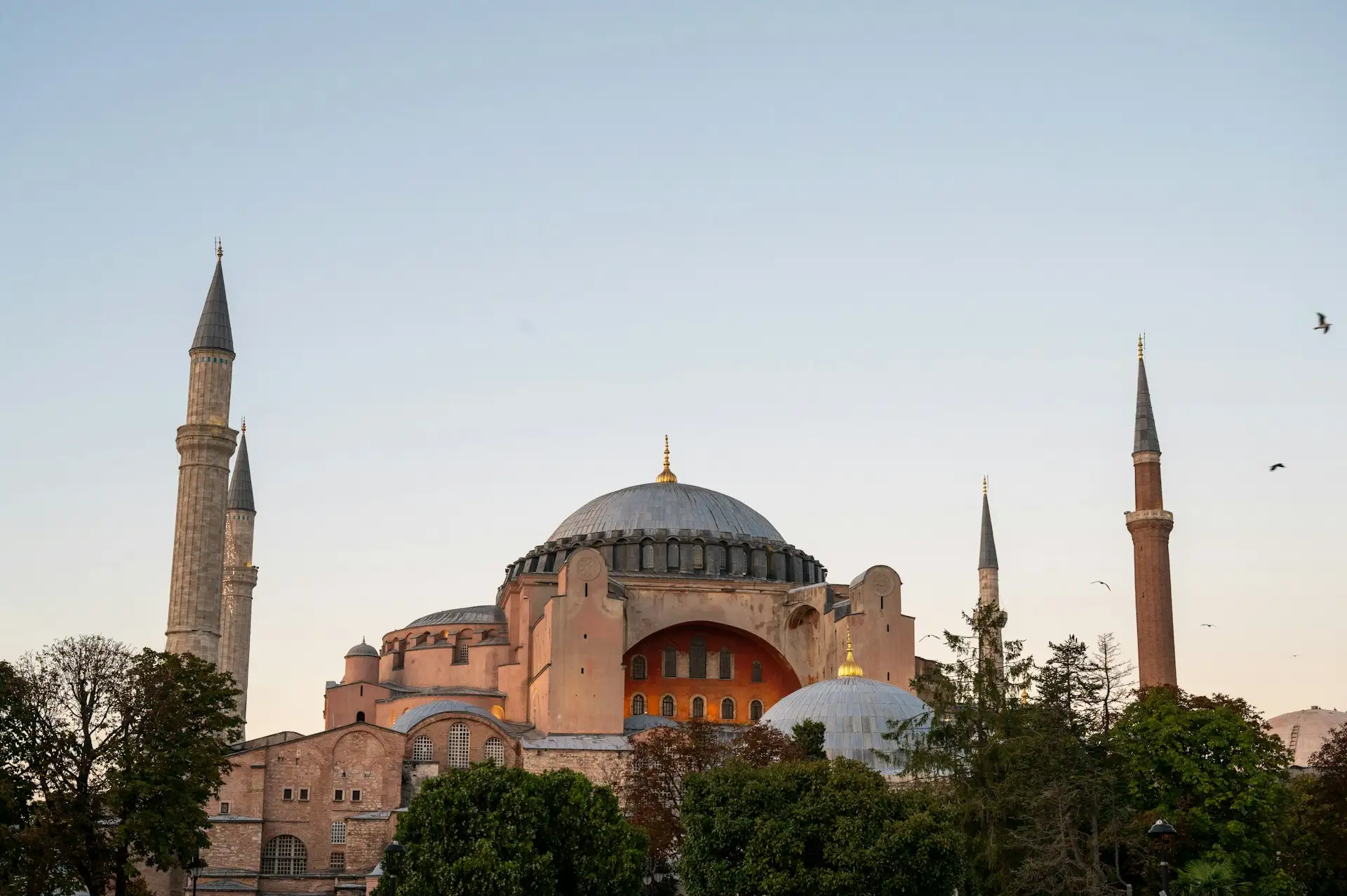
Hagia Sophia: A Complete Visitor's Guide to 1,500 Years of History (2026)
The definitive 2026 guide to Hagia Sophia — 1,500 years of Byzantine and Ottoman history, current opening hours, dress code, ticket details, and prayer-time tips.
Hagia Sophia is a sixth-century Byzantine cathedral that became an Ottoman mosque in 1453, a secular museum in 1934, and a working mosque again in 2020. Few buildings on Earth have lived four lives this distinct, and almost none of them are still load-bearing after fifteen centuries. Today it sits in the middle of İstanbul's historic peninsula, free to enter outside the five daily prayer times, and it remains the single most-visited landmark in the city — drawing roughly 13.6 million visitors in 2022 alone (Daily Sabah, 21 million visit Türkiye's Hagia Sophia Grand Mosque since reopening, 2023).
This guide is for first-time visitors who want to understand what they're actually looking at, not just where to queue. Hagia Sophia rewards context. Walk in cold and you'll see a beautiful building. Walk in knowing what Justinian was trying to outdo, why Mehmed II preserved instead of demolished, and what changed for tourists in July 2020, and you'll see a structure that has been continuously argued over for 1,500 years — and is still winning every argument by simply still being there.
Key Takeaways
- Hagia Sophia was completed in 537 CE under Emperor Justinian I and held the title of largest cathedral in the world for nearly 1,000 years.
- The Ottomans converted it to a mosque after the 1453 conquest of Constantinople; four minarets, a mihrab, and eight calligraphic medallions were added over the next four centuries.
- From 1934 to 2020 it operated as a secular museum under a cabinet decree issued during Atatürk's presidency. UNESCO inscribed it as part of the Historic Areas of İstanbul in 1985.
- In July 2020 Türkiye's Council of State annulled the 1934 decree and Hagia Sophia reopened as a working mosque. Ground-floor entry became free for all visitors.
- Since January 2024, non-Muslim tourists pay a separate ticket to access the upper gallery, home to the Deësis mosaic. Check the Türkiye Ministry of Culture and Tourism site for the current price.
Hagia Sophia at a Glance: 1,500 Years in One Building
The shortest version of the story has four dates. In 537 CE Justinian I dedicated his new cathedral in Constantinople, replacing a basilica burned in the Nika riots. In 1453 Mehmed II converted it to a mosque the week he conquered the city. In 1934 Atatürk's cabinet secularised it into a museum. In 2020 a court ruling sent it back to mosque status. Everything else is detail on those four hinge points.
The building sits in Sultanahmet, the historic peninsula at the eastern tip of European İstanbul. Directly across the square is the Blue Mosque. Across the street is the underground Basilica Cistern. Next door is Topkapı Palace, the Ottoman imperial residence. Behind Topkapı runs Gülhane Park. Five of İstanbul's most-visited sites cluster inside a five-minute walk of one another, which is why first-time visitors usually see them all in a single morning — a pattern we map in our one-day Sultanahmet walking itinerary.
Today Hagia Sophia operates as a mosque first and a tourist attraction second. That distinction matters. Entry is free. The dress code is enforced, not suggested. The building closes briefly five times a day for the daily prayers and entirely on Friday between roughly 12:00 and 14:30 for the Cuma congregational prayer. For most visitors the practical impact is mild — you simply plan your visit around the prayer schedule, the same way you'd plan around opening hours anywhere else.
The Byzantine Cathedral (537–1453): Justinian's Thousand-Year Project
The first Hagia Sophia on this site was a basilica built under Constantius II in 360. It burned in 404 during a riot. The second, built under Theodosius II, burned in 532 during the Nika revolt. Justinian I commissioned the third — the one still standing — and completed it in just five years and eleven months. The traditional dedication date is 27 December 537 CE. According to legend Justinian walked into the finished nave and declared, "Solomon, I have outdone thee" — almost certainly apocryphal, but the kind of legend that sticks because the building backs it up.
Justinian hired two geometers rather than traditional architects: Anthemius of Tralles and Isidore of Miletus. Their unusual training is part of why the dome reads as structurally improbable. They placed a vast central dome on four pendentives — curved triangular sections that transfer the dome's weight onto four enormous corner piers — and ringed the dome with 40 windows so that the load-bearing wall above the columns appears to float. The original dome collapsed in 558 after an earthquake. Isidore the Younger rebuilt it taller and with sturdier ribbing, and the rebuilt version is largely what stands today.
For 916 years Hagia Sophia served as the Eastern Orthodox cathedral of Constantinople, the seat of the Patriarch of Constantinople, and the ceremonial heart of Byzantine imperial rule. Coronations happened here. The schism of 1054, which formally split the Catholic and Orthodox churches, played out at the high altar when a papal legate dropped his bull of excommunication on the cathedral floor. In 1204 the Fourth Crusade sacked the building and stripped it of its mobile relics — a wound the Eastern church has never quite forgiven. By the time the Ottomans arrived in 1453, the structure was magnificent but neglected, parts of it propped up by visible scaffolding.
The Ottoman Mosque Era (1453–1934): Conversion, Minarets, Calligraphy
Mehmed II rode into Constantinople on 29 May 1453 and reportedly went straight to Hagia Sophia. Within days he had ordered it converted to a mosque, and the first Friday prayer was held inside the building on 1 June 1453. The choice to preserve rather than demolish the Byzantine cathedral was deliberate political theatre — Mehmed wanted Constantinople's most recognisable structure to anchor his new capital, but under his banner. The building has been continuously occupied ever since.
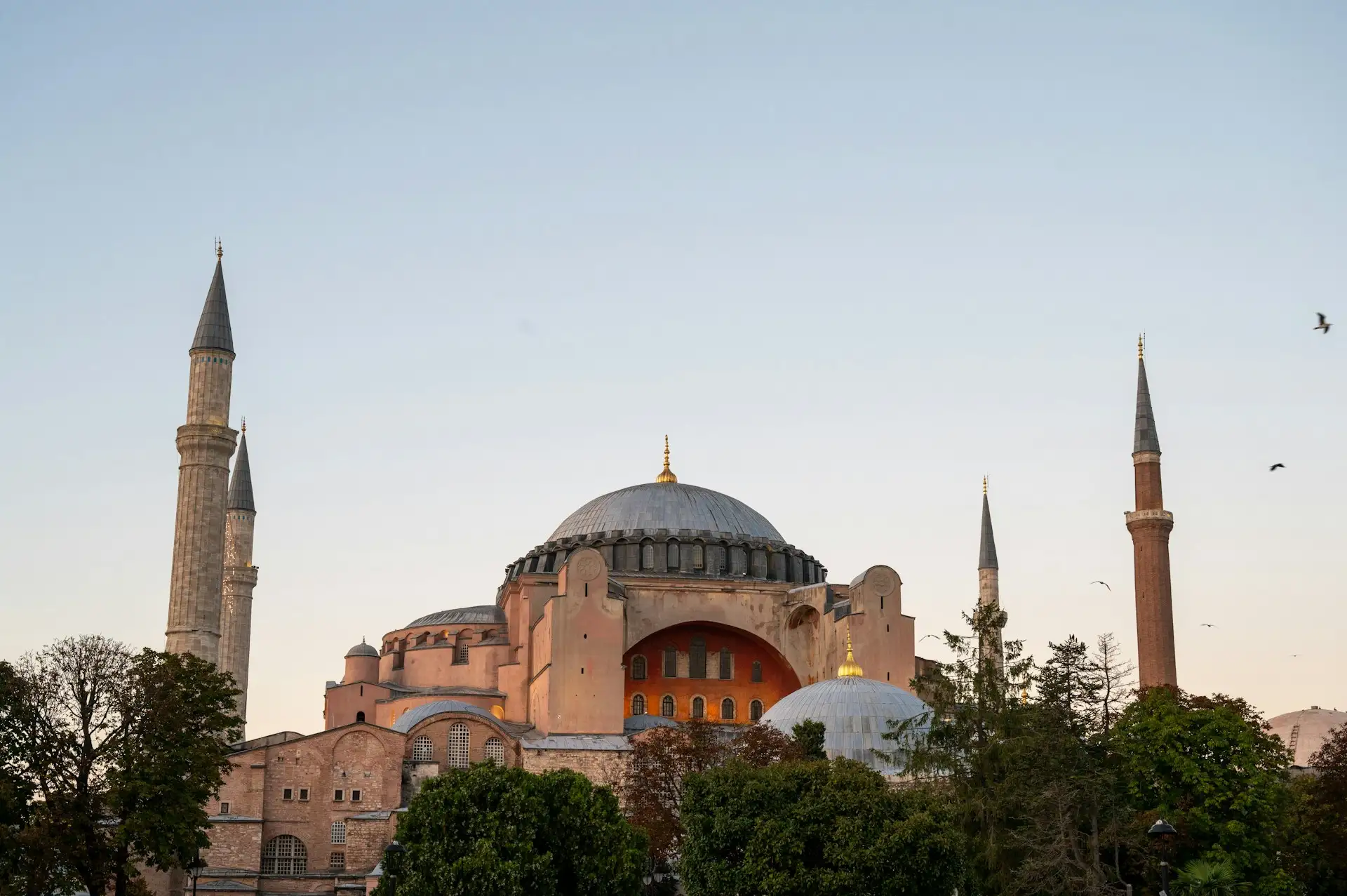
The Ottoman additions accumulated over three centuries and three sultans. Mehmed II added a wooden minaret immediately after the conquest — it no longer exists. The red-brick southeast minaret dates to the reign of Mehmed II or his successor Bayezid II. Bayezid II (r. 1481–1512) added the northeast minaret. The two identical, larger minarets on the western side were commissioned by Selim II in the late 16th century and designed by the great Ottoman architect Mimar Sinan. Together they give the building its current four-minaret silhouette. Inside, a mihrab was carved into the apse wall and oriented toward Mecca — which is why, if you stand in the centre of the nave today, the mihrab is noticeably off-axis from the original Byzantine east-west alignment. A minbar, a sultan's loge, and several elaborate lamp fixtures followed over the next two centuries.
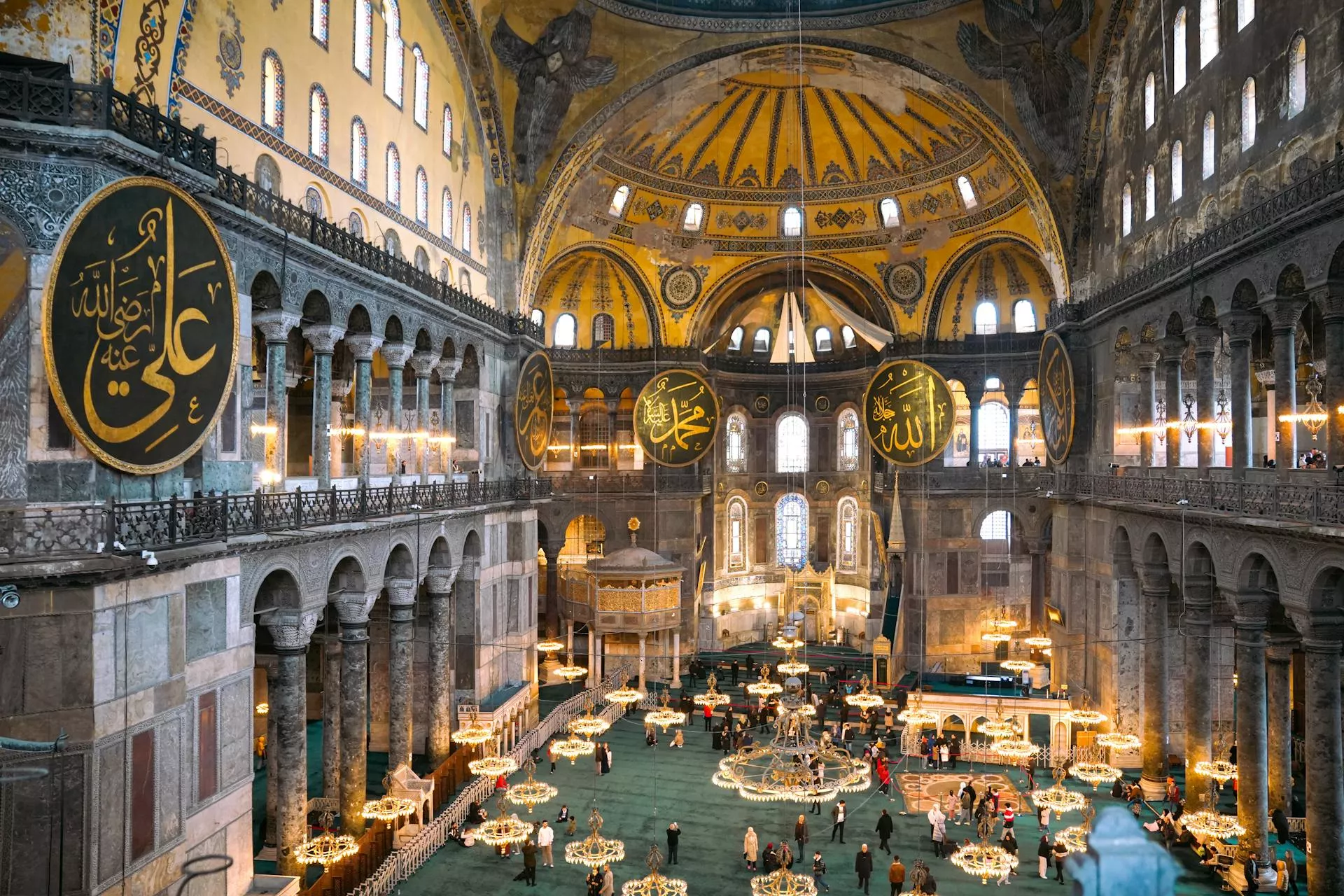
The most visually dominant Ottoman contributions are the eight giant calligraphic medallions hanging at gallery level. They were installed during restoration work in 1847–1849 under Sultan Abdülmecid I and executed by Kazasker Mustafa İzzet Efendi, one of the most respected calligraphers of the late Ottoman period. Each medallion is roughly 7.5 metres across and bears the name of Allah, the Prophet Muhammad, the first four Caliphs, or the Prophet's two grandsons. They remain the largest hanging calligraphic discs in the Islamic world. Sixteenth-century reinforcements by the great Ottoman architect Mimar Sinan — the buttresses you see propping up the exterior — arguably saved the dome a second time.
Crucially, figural Christian mosaics in the building were not destroyed during the Ottoman era. They were plastered over. That single conservation decision is the reason so much Byzantine artwork survives today — covered by Ottoman plaster, the mosaics sat protected and forgotten for nearly five centuries, waiting for the museum era to uncover them.
The Museum Era (1934–2020): Atatürk's Secular Bridge
On 24 November 1934 the Council of Ministers under Mustafa Kemal Atatürk issued a decree converting Hagia Sophia from a mosque into a museum. The official reopening as the Ayasofya Müzesi followed in 1935. For the next 85 years Hagia Sophia operated as a secular monument — neither church nor mosque — and that interval is when the Byzantine mosaics were systematically uncovered, conserved, and put back on public display for the first time in 481 years.
The restoration was led by Thomas Whittemore and the Byzantine Institute of America, which began its formal work on the building in 1931 and continued into the late 1940s. The Whittemore campaign carefully removed the Ottoman plaster covering the figural mosaics, photographed and documented each one, and stabilised the gold-leaf tesserae. The team also re-exposed the marble revetments on the lower walls and conserved the Byzantine columns. Most of what tourists photograph in the building today — the apse Virgin and Child, the Deësis, the donor portraits — was made visible during this campaign.
In 1985 UNESCO inscribed Hagia Sophia as part of a composite World Heritage Site called the Historic Areas of İstanbul (UNESCO World Heritage Centre, Historic Areas of Istanbul, 1985). The same listing covers four zones: the Sultanahmet archaeological park, the Süleymaniye Mosque quarter, the Zeyrek area around the former Pantocrator church, and the Theodosian land walls. The site was inscribed under three of UNESCO's cultural criteria — recognising its outstanding architectural masterpieces, its profound influence on architecture across Europe and the Near East, and its unique testimony to both Byzantine and Ottoman civilisation. That status created the international expectations that would shape the 2020 reconversion controversy 35 years later.
The 2020 Reconversion: What Changed for Visitors
On 10 July 2020 Türkiye's Council of State (Danıştay) annulled the 1934 cabinet decree that had secularised Hagia Sophia, ruling that the original 1453 conversion to a mosque had never been legally rescinded. A presidential decree the same day transferred administration of the building to the Diyanet İşleri Başkanlığı (Türkiye's Directorate of Religious Affairs), and Hagia Sophia reopened as a working mosque on 24 July 2020. The first Friday prayer drew tens of thousands of worshippers spilling into Sultanahmet square.
For visitors, the practical changes after the reconversion are concrete and easy to summarise. Entry became free for everyone, replacing the museum-era ticket. The building closes briefly five times a day for the standard Islamic prayers and entirely on Friday between roughly 12:00 and 14:30. The dress code is now mandatory rather than suggested — long trousers or skirts below the knee, shoulders covered, women cover their hair, shoes removed at the entrance. Some figural mosaics in the prayer hall are partially screened by hanging cloth during the prayer windows themselves, and fully visible outside them.
What did not change is the building or its artwork. Türkiye committed publicly that all Byzantine mosaics and architectural features would be preserved, and as of 2026 they have been — the mosaics remain in place, the marble revetments are untouched, and the dome interior is unaltered. The Daily Sabah reported that roughly 21 million visitors entered Hagia Sophia in the first three years after the July 2020 reopening, suggesting the reconversion has not dampened tourist demand (Daily Sabah, 21 million visit Türkiye's Hagia Sophia Grand Mosque since reopening, 2023).
The one cost change came in January 2024, when a separate ticket was introduced for non-Muslim tourists wishing to access the upper gallery — the level that holds the Deësis mosaic and the best photographic vantage of the central dome. The ticket is €25 per person as of 2026, with children under eight admitted free with an adult. Ground-floor access remained free for everyone. Confirm the current price on the official Türkiye Ministry of Culture and Tourism site before you go, as the figure is reviewed periodically.
What You'll See Inside: A Guided Walk-Through
Most visitors enter through the western imperial door, which sits beneath a late 9th- or early 10th-century mosaic of Christ Pantocrator with Emperor Leo VI prostrate before him in an act of imperial penance. This is the first piece of figural Byzantine artwork you'll see and one of the easiest to miss — look up and slightly back as you pass through. The narthex itself, the long vestibule running parallel to the nave, is paved in original Byzantine marble and was historically where catechumens waited during parts of the Orthodox liturgy.
The nave is the moment the building reveals itself. The central dome, 31 metres across and rising about 55 metres above the floor, hangs over the prayer hall on its ring of 40 windows. The four pendentives carry mosaic seraphim — six-winged angels, one in each corner. The seraph on the northeast was unveiled during the 2009 conservation campaign and is the clearest of the four; the others remain partly covered or restored. The Ottoman calligraphic medallions hang at gallery level, framing the prayer hall in a layer of Islamic typography that visually overlays the Christian iconography above.
The apse holds the most important surviving Byzantine mosaic in the building: an enthroned Virgin and Child, inaugurated by Patriarch Photios on 29 March 867 with a famous sermon describing the figures as appearing to live and breathe within the golden tesserae — the first major figural mosaic the Byzantines installed once image-veneration was restored after the end of the Iconoclasm period. It is the first major figural mosaic the Byzantines installed once image-veneration was restored, and it has survived the conversions, the museum era, the reconversion, and the conservation campaigns more or less intact. The Ottoman mihrab and minbar sit beneath it; if you frame a photo from the centre of the nave you can capture both eras in one shot.
The upper gallery — accessible via a ramped spiral passage on the north side, paid ticket required for non-Muslim tourists as of 2024 — holds the building's other masterpiece. The Deësis mosaic, dating to roughly 1261 — installed after the Byzantines recovered Constantinople from the Crusaders — shows Christ flanked by the Virgin Mary and John the Baptist in attitudes of intercession. It is widely considered the finest Byzantine mosaic in existence. The faces are partly damaged but the modelling and emotional restraint remain extraordinary; the figures look like real people thinking about real things, which is unusual for Byzantine art and partly why Western art historians often single this work out.
The Mosaics: A Visual Guide to What Survives
Roughly a third of Hagia Sophia's original Byzantine mosaic program survives, and almost all of it dates from after the Iconoclasm period (726–843 CE), when figural religious imagery was systematically destroyed across the Byzantine Empire by imperial decree. The mosaics you see today were therefore installed in a deliberate post-Iconoclasm restoration program intended to reaffirm the legitimacy of religious images, and they were chosen and placed with that argument in mind.
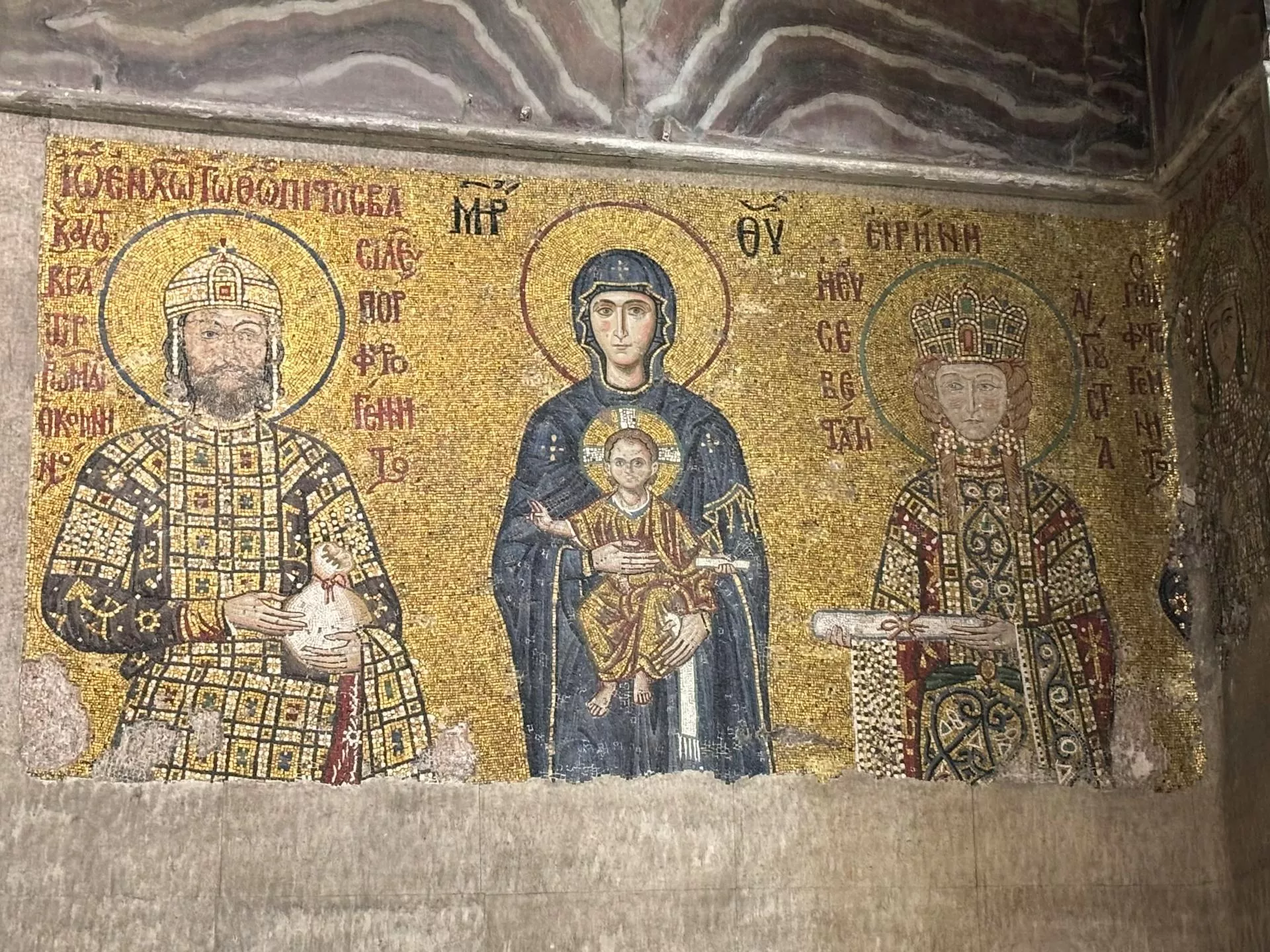
The headline surviving works are five. The apse Virgin and Child (~867 CE) sits above the mihrab and is the centrepiece. The Imperial Door Pantocrator (~10th century) shows Christ enthroned with Emperor Leo VI prostrate before him. The southwest vestibule mosaic (~10th century) depicts the Virgin Mary flanked by Emperor Constantine offering her the city of Constantinople and Emperor Justinian offering her Hagia Sophia itself — a foundation panel made retrospectively, four centuries after both emperors died. The Komnenos panel (~12th century), in the upper south gallery, shows the Virgin and Child flanked by Emperor John II Komnenos and Empress Irene of Hungary. And the Deësis (~1261), also in the upper gallery, completes the surviving canon.
Since the 2020 reconversion, the figural mosaics in the prayer hall — primarily the apse Virgin and Child and the imperial door Pantocrator — are partly veiled by hanging cloth during the five daily prayer windows. Outside of those prayer times they are fully visible. The upper-gallery mosaics, including the Deësis and the Komnenos panel, are not covered during prayers because the upper gallery is not used as part of the prayer hall. This is why the upper-gallery ticket is the one most serious art-history visitors quietly recommend paying for.
Planning Your Visit: Hours, Tickets, Dress Code, Prayer Times
Hagia Sophia is open to non-worshipping visitors throughout the day except during the five short prayer windows and the longer Friday closure for Cuma prayer. Exact opening and closing times shift with the season — typically 09:00 to 18:00 in winter and later in summer, with the last entry usually 30 to 60 minutes before closing. Confirm the current schedule on the Diyanet's official website before you go, as adjustments are made for Ramadan and for daylight-saving transitions.
The five daily Islamic prayers — Fajr (pre-dawn), Dhuhr (midday), Asr (afternoon), Maghrib (sunset), and Isha (night) — close the building to tourists for roughly 15 to 30 minutes each. Prayer times shift seasonally with sunrise and sunset, so the schedule on a January morning looks very different from a July morning. The Diyanet İşleri Başkanlığı publishes daily prayer times for İstanbul on its official site and in its smartphone app, and most tourists find checking the app the night before is the simplest way to plan around them.
Tickets are simple. Ground-floor entry is free for all visitors. The upper gallery has carried a separate paid ticket for non-Muslim tourists since January 2024 — verify the current price on the Türkiye Ministry of Culture and Tourism site rather than relying on third-party figures, which go stale quickly. Bring photo ID; large bags are scanned at the security checkpoint.
The dress code applies to every visitor regardless of religion. Long trousers or skirts must cover the knees. Shoulders must be fully covered. Women must cover their hair with a scarf — scarves are available free at the door if you arrive without one. Shoes are removed at the entrance and stored in plastic bags you carry through the building. Hand-held photography without flash is permitted throughout; tripods and professional equipment require advance permission.
How to Skip the Queues: Best Times of Day, Week, and Year
The single best queue-avoidance trick in Sultanahmet is to arrive 15 minutes before a prayer window ends and queue at the visitor entrance. The previous wave of tourists has been cleared from the prayer hall, the next wave has not yet arrived, and the moment the mosque reopens to visitors you walk straight in. This works particularly well after Dhuhr (midday prayer) and Asr (afternoon prayer), when other tourists assume the building is closed and skip it for lunch.
The worst times are predictable. Friday between 12:00 and 14:30 is the universal closure for Cuma prayer, no exceptions. Saturday morning in peak season — April–May and September–October — produces the longest queues of the week because European city-break travellers cluster on weekends. The 11:00 to 12:00 window any day of the year tends to be congested because tour groups try to fit Hagia Sophia in before lunch. If your schedule allows, target Tuesday or Wednesday around 09:30, immediately after the first morning prayer cycle ends.
Off-season changes the experience entirely. November and February — colder, sometimes drizzly, but mild compared to northern Europe — produce short queues, half-empty prayer halls, and the kind of light through the dome windows that the building was designed for. If you can choose your travel month, those two are the locals' recommendation for a contemplative visit. If you can't, the 30-minutes-after-a-prayer rule is the best fallback any time of year.
What's Within a 5-Minute Walk of Hagia Sophia
Hagia Sophia anchors the densest tourist square kilometre in İstanbul. Within a five-minute walk you can reach five of the city's headline sights, all on foot, no metro and no taxi required. This is the cluster that makes one-day İstanbul itineraries possible — when first-time visitors talk about "doing Sultanahmet," this five-stop loop is what they mean.
The Blue Mosque (Sultanahmet Camii) sits directly across the square, about 90 seconds on foot from Hagia Sophia's visitor exit. Where Hagia Sophia is a Byzantine cathedral re-skinned by the Ottomans, the Blue Mosque is a purpose-built Ottoman mosque from 1616 — six minarets, a cascade of half-domes, and the famous İznik tile interior that gives it its English name. Visiting both back-to-back is the clearest way to feel the difference between Byzantine and Ottoman ideas of sacred space.
The Hippodrome (Sultanahmet Meydanı) is the long open square between Hagia Sophia and the Blue Mosque. It was the Byzantine chariot stadium where political factions rioted, emperors lost their thrones, and the Nika revolt destroyed the second Hagia Sophia in 532. Today three monuments survive at its centre — the Egyptian Obelisk of Thutmose III, the bronze Serpent Column from Delphi, and the Walled Obelisk — making it one of the longest continuously-occupied public squares in Europe.
The Basilica Cistern (Yerebatan Sarnıcı) sits across the street from Hagia Sophia, about 60 seconds away, accessed by a stairway down from street level. Built under Justinian I in the 6th century to supply the Great Palace with water, it is now an atmospheric underground space full of recycled Roman columns, two famous Medusa-head plinths, and shallow water pierced by walkways. It takes 30–45 minutes to visit and is a strong sensory contrast after the daylight intensity of Hagia Sophia.
Topkapı Palace is the Ottoman imperial residence, with its main gate roughly two minutes' walk from Hagia Sophia. Allow three hours minimum — the four courtyards, the Harem (separate ticket), the Imperial Treasury, and the Sacred Relics rooms together form one of the most comprehensive Ottoman museum complexes in the world. Gülhane Park, the former palace garden, sits downhill behind Topkapı and is free, green, and the city's most central place to sit down for fifteen minutes.
If you're trying to see all five in a single morning, our İstanbul 24-hour walking itinerary maps the exact distances, allocates prayer-time gaps, and clocks the order to visit them in. For a slower pace that pairs Sultanahmet with a Bosphorus day, the 48-hour first-timer itinerary keeps the cluster on Day 1 and frees Day 2 for Galata, Dolmabahçe, and a dinner cruise.
Fitting Hagia Sophia Into a 1- or 2-Day İstanbul Trip
A thorough ground-floor visit to Hagia Sophia takes 60 to 90 minutes if you actually look at the mosaics, walk the perimeter of the nave, and read the calligraphy. Add another 30 minutes if you commit to the upper gallery and the Deësis. A speed visit can be done in 30 minutes, but you'll skip the apse mosaic interpretation, miss the calligraphic context, and basically just verify that the building is big. For a once-in-a-lifetime trip, 90 minutes is the right floor.
On a one-day İstanbul plan, Hagia Sophia is the mid-morning anchor — typically 10:00 to 11:30, deliberately ending before the Dhuhr prayer closure and the 11:00 tour-bus wave. That timing leaves the early afternoon for Topkapı Palace, the late afternoon for the Basilica Cistern, and the early evening for the Grand Bazaar. Our one-day İstanbul itinerary blocks exactly this rhythm, with prayer-time buffers baked in.
On a two-day plan, Hagia Sophia opens Day 1 and the rest of Sultanahmet fills out the afternoon, leaving Day 2 entirely free for the Bosphorus shore, Galata, and the bazaars. This is the cleanest split the city offers and the one most first-time visitors settle into. Our two-day İstanbul itinerary follows that structure exactly and ends on a Bosphorus dinner cruise from Kabataş.
Repeat visitors and serious Byzantine-art enthusiasts often go back a second time specifically for the upper gallery and the Deësis mosaic. The paid gallery ticket is the right purchase on that second visit, when you've already absorbed the ground-floor narrative and are ready to spend an hour with three faces.
Frequently Asked Questions
Is Hagia Sophia a church or a mosque in 2026?
It is a working mosque, reconverted in July 2020 after 85 years as a secular museum. Non-Muslim visitors are welcome outside the five daily prayer windows, must dress modestly, and enter through a separate visitor door. The Byzantine Christian mosaics remain in place and are visible most of the day.
How much does it cost to visit Hagia Sophia?
Ground-floor entry is free for all visitors. Since January 2024, non-Muslim tourists who want to visit the upper gallery — home to the Deësis mosaic — pay a separate ticket. Confirm the current price on the Türkiye Ministry of Culture and Tourism site before you go, as the figure is adjusted periodically.
What's the dress code at Hagia Sophia?
Long trousers or skirts below the knee, shoulders fully covered, and a head covering for women. Shoes are removed at the entrance, so bring socks. Scarves are available free at the door if you arrive without one. The dress code applies to every visitor regardless of religion or gender.
When is the best time to visit Hagia Sophia to avoid queues?
Tuesday or Wednesday around 09:30 has the shortest queues. Avoid Friday between 12:00 and 14:30 — the building is closed entirely for Cuma prayer — and avoid Saturday mornings in peak season. Arriving 15 minutes before a prayer window ends and queuing at the visitor entrance is the fastest entry trick.
How long does a visit to Hagia Sophia take?
Plan 60 to 90 minutes for the ground floor and an extra 30 minutes if you add the upper gallery. A speed visit is possible in 30 minutes but skips the apse mosaic, the calligraphy context, and the sultan's loge. Most visitors who care about the history allocate 90 minutes for a single comprehensive walk-through.
Can you take photos inside Hagia Sophia?
Yes, hand-held photography without flash is permitted throughout the building. Tripods and professional equipment require advance permission from the administration. During the five daily prayers, the prayer area is off-limits to tourists, and photographing worshippers directly is discouraged out of courtesy.
Where is Hagia Sophia and how do you get there?
Hagia Sophia sits in Sultanahmet on İstanbul's historic peninsula, directly across the square from the Blue Mosque. The T1 tram stops at Sultanahmet station, a two-minute walk away. From Taksim Square it is about a 25-minute tram ride; from İstanbul Airport, roughly 70 minutes via the M11 metro and the T1 tram.
Plan Your Visit on Stadtly
Hagia Sophia is the kind of building that rewards planning, but it doesn't reward over-planning. Pick your day, check the prayer schedule the night before, dress for the rules, and arrive with one piece of context per major piece of artwork — the date, the era, and the argument it was making. Ninety minutes inside and you'll leave understanding why the same building keeps getting reconverted: it has been the most important room in the city for fifteen hundred years, and whoever holds it gets to define what the city stands for.
If you're ready to plan the rest of your trip around Hagia Sophia, start with our 24-hour İstanbul plan for a walkable Sultanahmet day, or stretch it into a 48-hour first-timer route that pairs the historic peninsula with the Bosphorus. Both itineraries are built on Stadtly's map, fully editable, and free to save, share, or export as a PDF before you fly.
Planning a trip to Istanbul?
Discover attractions, hotels and tours to build your perfect itinerary.
Explore Istanbul