İstanbul in 48 Hours: A Two-Day Itinerary for First-Timers (2026)
Two days in İstanbul — Sultanahmet on Day 1, Bosphorus on Day 2. Blue Mosque, Hagia Sophia, Topkapı, Whirling Dervishes, Grand Bazaar, Galata, Dolmabahçe, dinner cruise. Full route on Stadtly.
Two days is the sweet spot for a first İstanbul visit. One day gets you the Sultanahmet headline sights and almost nothing else. Three days starts to feel like a holiday. Forty-eight hours is the cleanest split the city offers — a walking-museum day on the historic peninsula, and a waterfront day that ends with the Bosphorus lit up from a dinner-cruise deck. In 2024, İstanbul welcomed roughly 18.6 million international visitors (Hürriyet Daily News, İstanbul welcomed more than 18 million visitors last year, 2025), and the 2-day rhythm is the one most of them settle into.
This plan is built around two anchors. Day 1 stays inside the historic peninsula and finishes with the Sema ceremony at HodjaPasha. Day 2 starts in the bazaars and finishes on a private-table dinner cruise from Kabataş. Every stop is on the same Stadtly map — open it, follow it, or duplicate it and remix it into your version.
Key Takeaways
- The 48-hour split that works: Day 1 in Sultanahmet on foot, Day 2 from the bazaars north to Galata, Karaköy and the Bosphorus shore.
- The four closure days to plan around: Topkapı closed Tuesdays, Dolmabahçe closed Mondays, Grand and Spice Bazaars closed Sundays, Hagia Sophia tourist-closed Friday 12:00–14:30.
- Day 2's only non-walking leg is one short T1 tram ride between Karaköy and Kabataş — about 5 minutes on the Istanbulkart you bought at the airport.
- The Mevlevi Sema ceremony at HodjaPasha is on UNESCO's Intangible Cultural Heritage list (UNESCO ICH, Mevlevi Sema ceremony, 2008) — it's a Sufi prayer, not a folk show.
👉 Open the full 48-hour itinerary on Stadtly
👉 Want to remix it? Open the map, hit duplicate, build your own 48 hours: 48-hour itinerary on Stadtly
The 48-Hour Plan at a Glance
Two days in İstanbul split cleanly along the Golden Horn. Day 1 stays inside the historic peninsula on foot — Blue Mosque, Hippodrome, Hagia Sophia, Basilica Cistern, Topkapı Palace, capped by the Sema ceremony at HodjaPasha in Sirkeci. Day 2 moves north: Grand Bazaar, Eminönü Square, Spice Bazaar, across Galata Bridge to Galata Tower and Beyoğlu, Galataport, Dolmabahçe Palace, and a private-table Bosphorus dinner cruise from Kabataş.
The rhythm matters. Day 1 is a walking-museum day — long mornings inside Byzantine and Ottoman buildings, an afternoon swallowed whole by Topkapı, and an evening that ends with a 60-minute Sufi ritual instead of a late dinner. Day 2 is the opposite: a fast morning through two markets, an afternoon of waterfront and views, and a 3-hour dinner cruise that doubles as your Bosphorus tour and your evening meal in one window.
Four closures decide your start day. Topkapı is closed Tuesdays, Dolmabahçe is closed Mondays, the Grand and Spice Bazaars are closed Sundays, and Hagia Sophia is tourist-closed every Friday between 12:00 and 14:30. A Wednesday-to-Friday arrival hits all four sights at full operating hours; a Sunday-to-Monday arrival kills your bazaar morning and your Dolmabahçe afternoon at once.
The closure pattern most 2-day guides bury: if you only get to pick one weekday to land on, pick Wednesday. Wednesday → Thursday is the one 48-hour block where every sight on this itinerary is open without scheduling around mid-day prayer closures or weekly dark days.
Where to Start: Four Doors Hotel and a Sultanahmet Base
Your base for Day 1 decides whether the morning is paced or panicked. A Sultanahmet hotel puts every Day 1 sight inside a 10-minute walk, solves the mosque dress-code problem on the way out the door, and shaves 45 minutes off the daily transit tax you'd pay from a Beyoğlu hotel. Four Doors Hotel sits a short walk from the Hippodrome, with a rooftop that frames the Blue Mosque and Hagia Sophia in the same morning panorama.
A Turkish breakfast is the right fuel for a long walking day. Menemen, simit, beyaz peynir, olives, and as much çay as the waiter will pour. It's the kind of meal that's slow on purpose; give it 45 minutes and then leave. Out the door by 8:30 — the Blue Mosque opens at 9:00 and there's a real queue advantage to being there inside the first half-hour, both for the light through the İznik tiles and to clear the building before the noon prayer pause.
A Sultanahmet hotel also solves the dress-code problem in one decision. Step out in long trousers and a shirt with sleeves and you're appropriate for every mosque on the day — no mid-morning detour to change.
Travelling with even less time? The plan compresses cleanly to one day if you skip Day 2 entirely: İstanbul in 24 Hours: The Essential One-Day Itinerary is the same Sultanahmet loop without the Bosphorus side.
Day 1 Morning: Blue Mosque, Hippodrome and Hagia Sophia (8:30 am – 12:00 pm)
The three foundational sights of the historic peninsula are clustered around one open square — Sultanahmet Square, historically the Hippodrome. Start at the Blue Mosque on the south side, walk one minute to the Hippodrome obelisks, then cross to Hagia Sophia. Total walking distance for the whole morning is under 400 metres. You'll spend more time taking off your shoes than walking.
The Blue Mosque (Sultan Ahmed Mosque)
The Blue Mosque is a working mosque first and a sight second, which matters for your timing. It closes to visitors during the five daily prayer windows (each one is roughly 30 minutes), so the safest visit is right at the morning open. The interior is named for the more than 20,000 hand-painted İznik tiles that line the upper walls and the dome cascade — the blue is paler than most photos suggest, and it shifts with the time of day. Six minarets, four giant pillars, and a horizontal calm that's the exact opposite of Hagia Sophia next door.
Dress code: shoulders and knees covered, headscarves for women. Both scarves and skirt-covers are handed out free at the entrance. Tap the attraction card on the Stadtly map for the live ticket-and-hours info — entry to the mosque itself is free, but the on-site donation point and the prayer schedule both shift week to week.
The Hippodrome (Sultanahmet Square)
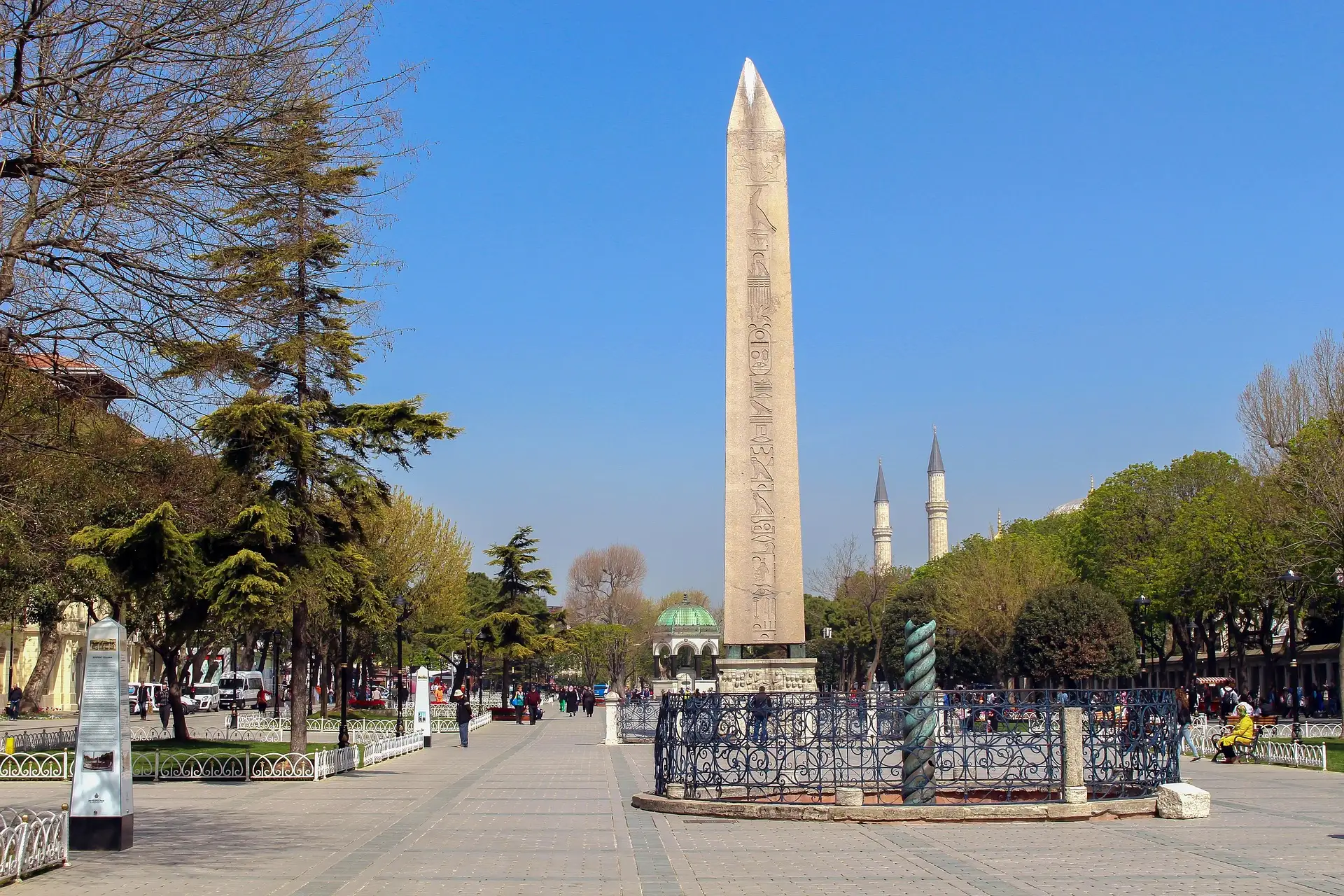
The open square between the Blue Mosque and Hagia Sophia is the Hippodrome — the chariot-racing arena of Roman and Byzantine Constantinople. Don't walk through it. Stop for 20 minutes. Three monuments still stand in a line down the central spina: the Obelisk of Theodosius (originally cut for Pharaoh Thutmose III around 1450 BCE, shipped from Karnak in 390 CE), the spiral Serpent Column brought from Delphi by Constantine, and the rough-stone Walled Obelisk at the south end. Three monuments, three different empires, one square.
Read our definitive guide on the Sultanahmet Squre.
Hagia Sophia
Hagia Sophia is the one visit that genuinely earns its hype. Consecrated in 537 CE, the central dome was the largest in the world for nearly a thousand years. Since 2020 it's been operating as a working mosque again, with visitor access reorganised in early 2024 around an upper-gallery route while the ground-floor prayer area is kept separate. The entrance fee for foreign visitors is €25, introduced in January 2024 (Time Out, Turkey introduces €25 fee to visit the Hagia Sophia Grand Mosque, 2024).
In 2022 alone the building hosted about 13.6 million visitors (Daily Sabah, 21 million visit Türkiye's Hagia Sophia Grand Mosque since reopening, 2023). That's roughly 37,000 a day. You're not going to be alone in there. Focus on three things: the central dome, the seraphim mosaics in the pendentives, and the Deësis mosaic in the upper south gallery. Budget 75 minutes minimum.
For more information, view our definitive Hagia Sophia guide
Day 1 Afternoon: Basilica Cistern, Lunch and Topkapı Palace (12:00 pm – 5:00 pm)
The afternoon is the most time-hungry stretch of the whole 48-hour plan. The Basilica Cistern across from Hagia Sophia takes 30–45 minutes underground, a Sultanahmet lunch resets you for 90 minutes, and Topkapı Palace eats the next three hours whole. Buy the combined Palace + Harem ticket online before you fly — the on-site queue at the second-courtyard gate can swallow 40 minutes in summer.
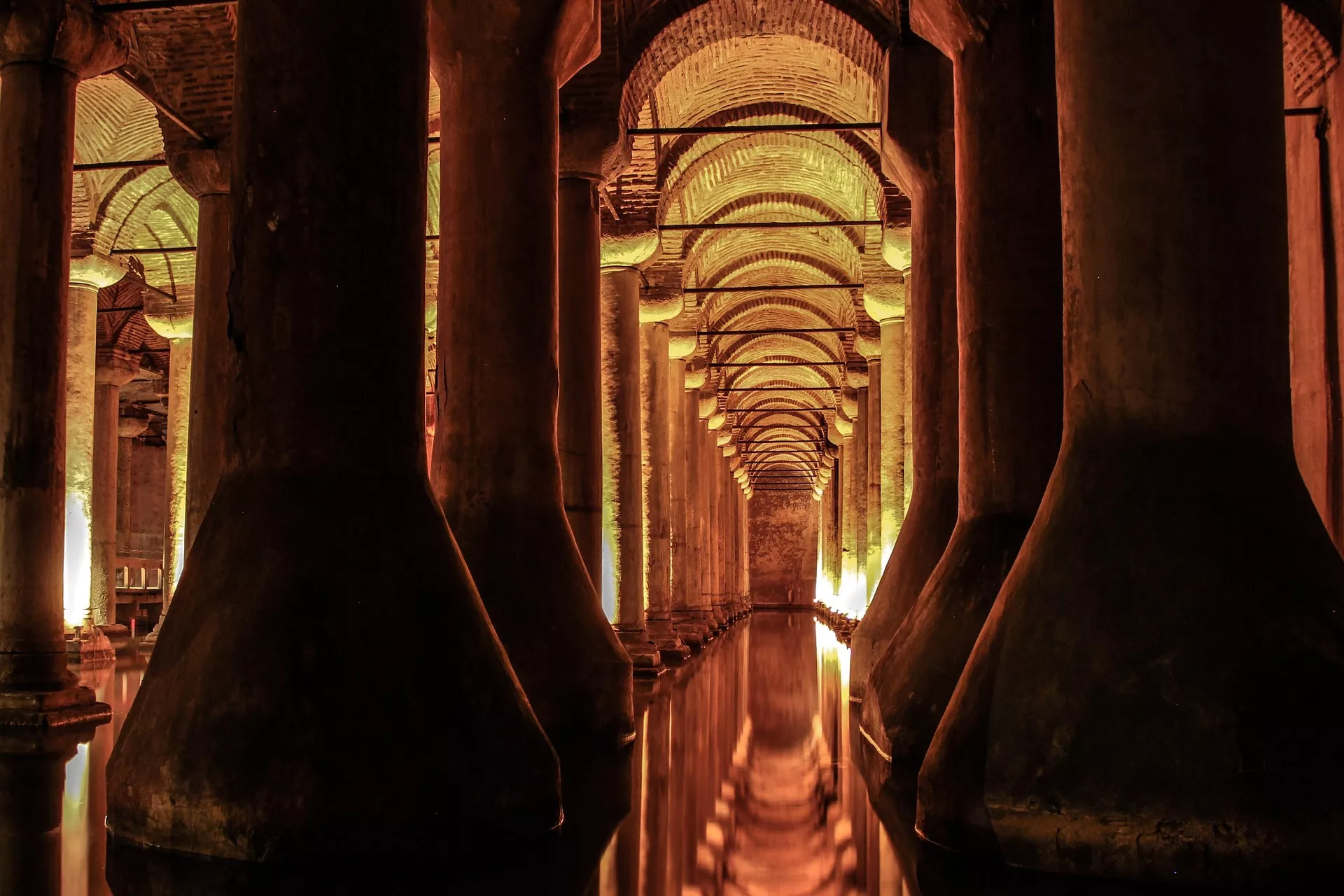
The cistern was built in 532 CE under Emperor Justinian I to supply the Great Palace. It closed for restoration in 2017 and reopened on 22 July 2022 after the most extensive renovation in its history — the İBB Miras team removed roughly 1,440 m³ of mid-20th-century concrete and 1,600 m³ of sediment to expose the original Byzantine brick floor (Türkiye Today, İstanbul's Basilica Cistern: Ancient marvel, modern exhibition site, 2024). The two upside-down Medusa-head column bases at the back are the photo. The Hen's Eye column near the entrance is the second photo.
For lunch you've got three honest options within five minutes of the cistern exit. A Sultanahmet köftecisi for grilled meatballs and white-bean salad if you want the classic local lunch. A walk-up lahmacun spot if you're behind schedule. A sit-down Ottoman menu around Cağaloğlu if you want a proper reset before Topkapı.
Our take: Don't skip lunch. Topkapı's on-site café options are limited and overpriced, and the palace itself is enormous. Walking through three hours of imperial treasure rooms on an empty stomach is how 48-hour itineraries fall apart at 4 pm.
Topkapı Palace — what to actually prioritise in three hours
Topkapı is laid out as four courtyards stepping back toward the Bosphorus. You enter through the first courtyard (free public space), pay at the second courtyard's gate, and the real visit begins inside. The combined ticket including the Harem and Hagia İrene runs around 2,750 TL (about €55) for foreign visitors in 2026 (The İstanbul Insider, Entrance fees of İstanbul's main tourist attractions in 2026, 2026). The İstanbul Museum Pass is included for the palace itself but does not cover the Harem or Hagia İrene, both of which need separate add-ons.
- Second courtyard — Imperial Council chamber and the views of the kitchens (now ceramic galleries). Twenty minutes.
- Third courtyard — Treasury. The time-hungry one. The Topkapı Dagger, the 86-carat Spoonmaker's Diamond, gold cradles, ceremonial thrones. Forty-five minutes minimum.
- Third courtyard — Privy Chamber and Holy Relics. A sealed, hushed room with relics including the mantle of the Prophet and the swords of the Four Caliphs. Thirty minutes.
- The Harem. Separate ticket, separate entrance off the second courtyard. Four hundred-plus rooms behind a single guarded gate; you'll walk through perhaps twenty of them. The single highest-value 45 minutes on the entire 2-day route.
- Fourth courtyard — the terrace. Step out onto the marble veranda and you're suddenly above the Bosphorus, with Asia on the other shore and the Golden Horn off to your left. Half an hour. Sit down.
When you're behind schedule, the Carriage House and some of the Treasury's secondary halls (Imperial Costumes, Portraits) are the right cuts. The Harem is not a cut. The Fourth Courtyard terrace is not a cut.
Day 1 Evening: Whirling Dervishes at HodjaPasha and a Sultanahmet Dinner (6:30 pm – 10:00 pm)
End Day 1 with the Sema ceremony at HodjaPasha Culture Center in Sirkeci — a 60-minute Sufi whirling ritual staged inside a restored 15th-century hammam. The venue itself is a piece of the story: it occupies the Hocapaşa Hamamı, a double bathhouse from the reign of Sultan Mehmed II (Hodjapasha Culture Center, History, 2026), and the main hall sits under the original men's section's dome. The walk from Topkapı's exit down to Sirkeci is 10 to 15 minutes, mostly downhill — Day 1 stays fully on foot.
The Sema isn't a folk show. It's the ritual prayer of the Mevlevi Sufi order, founded in Konya in 1273 by followers of Rumi, and on UNESCO's Representative List of the Intangible Cultural Heritage of Humanity since 2008 (UNESCO ICH, Mevlevi Sema ceremony, 2008). The dervishes rotate on their left foot, right palm turned to the sky and left palm to the earth — a moving meditation, not a performance. Etiquette: no photography during the ceremony, no applause until the end, smart-casual dress is fine. Tap the HodjaPasha card on the Stadtly map for the live booking link and the day's start time.
After the ceremony, stroll fifteen minutes back into Sultanahmet for dinner. The light on Hagia Sophia is floodlit-orange by 9:00 pm and most rooftop restaurants on Akbıyık Caddesi keep kitchens open until 10. If your legs are done, Sirkeci has a handful of quieter Ottoman menus within five minutes of HodjaPasha's exit — fewer tourists, similar prices, faster service.
Day 2 Morning: Grand Bazaar, Eminönü Square and Spice Bazaar (9:00 am – 12:30 pm)
Day 2 begins back inside the historic peninsula, but the rhythm changes. Bazaars instead of monuments, smells instead of mosaics. Start at the Grand Bazaar's Beyazıt Gate, work north through the textile and ceramic halls, exit toward Eminönü Square, then thread through the Spice Bazaar before crossing the Galata Bridge.
The Grand Bazaar opens at 10:00 and is closed Sundays. In 2022 it drew about 39.77 million visitors after its 2021 restoration (GoTürkiye, İstanbul's Grand Bazaar hosts almost 40 million visitors in 2022), which works out to roughly 100,000 a day across around 2,500 shops on 61 covered streets. Spend 75 minutes; prioritise the Cevahir Bedesten at the heart for antiques and Ottoman silver, the textile and ceramic alleys running east-west, and the jewellery hall (Kalpakçılar Caddesi) where the gold prices are widely posted.
Realistic haggling rule in two sentences: the first price is rarely the price, and a polite counter at 60–70% is normal. If a vendor invites you in for çay, the tea is free and doesn't oblige you to buy — but it does oblige you to spend ten minutes being friendly.
Exit north through Mahmutpaşa toward Eminönü Square, the transit-and-ferry plaza below the New Mosque. The grilled-fish sandwiches (balık-ekmek) sold off the boats at the Golden Horn pier are the local lunch-on-the-go — about €4, eaten standing up while the tram pulls in and out behind you.
For more information, view our definitive the Grand Bazaar guide
The Spice Bazaar (Mısır Çarşısı) is much smaller and faster than the Grand Bazaar — 45 minutes is enough. The L-shaped Ottoman market was completed in 1664 as part of the New Mosque complex; saffron, Turkish delight, dried apricots, sumac, and herbal teas are the buys. Most stalls take card cleanly.
Day 2 Afternoon: Galata Bridge, Galata Tower and Beyoğlu (12:30 pm – 4:00 pm)
Crossing the Galata Bridge is the geographic and atmospheric pivot of the whole 48-hour itinerary. You walk from the Ottoman-Byzantine peninsula into the 19th-century European quarter in about 600 metres, with fishermen rod-fishing on the upper deck and fish restaurants stacked along the lower deck. Eat on the lower deck if you're hungry, or save your appetite — Beyoğlu has the better afternoon coffee.
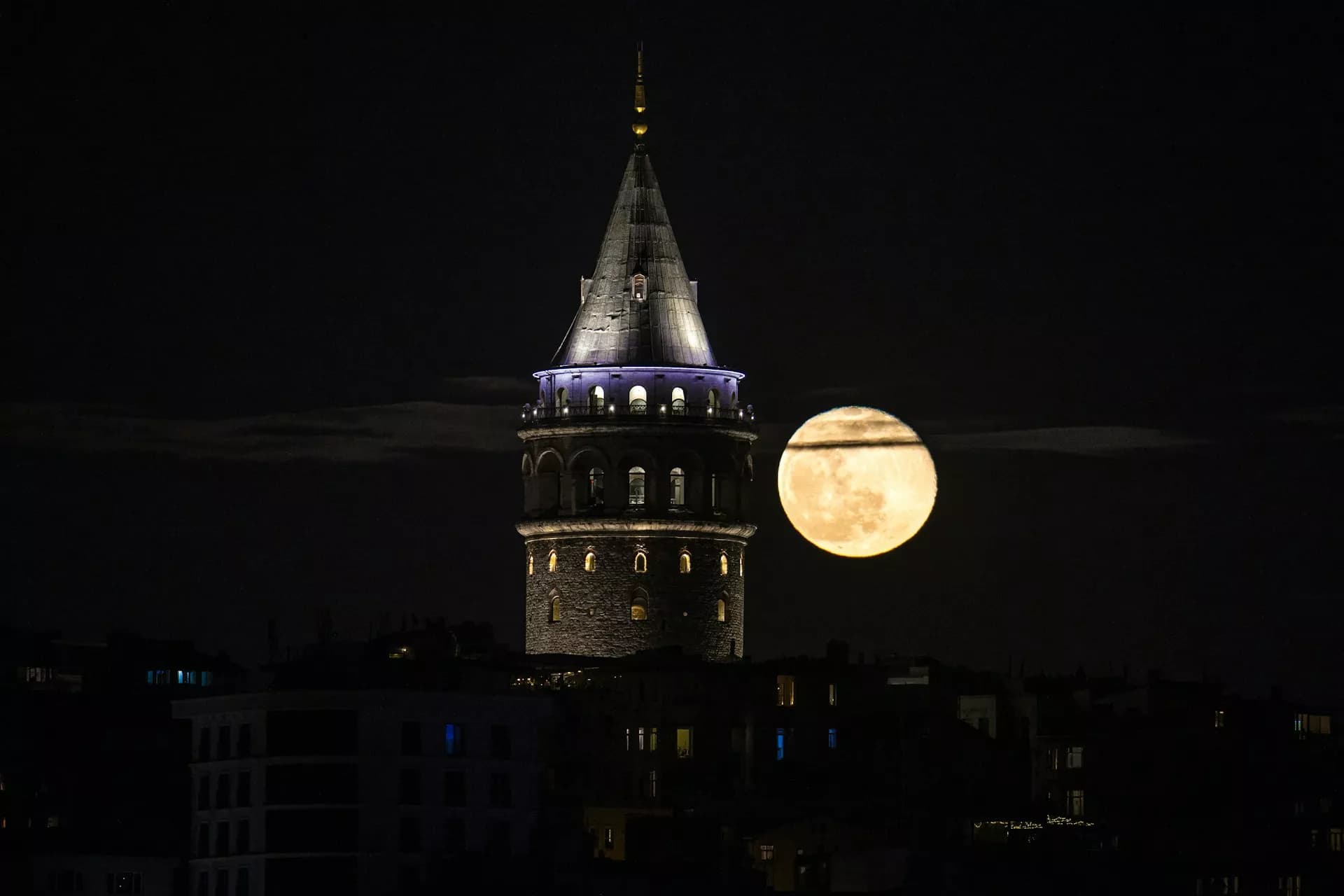
From the bridge's north end it's a 10–12 minute walk uphill to Galata Tower, the medieval Genoese stone tower whose current structure dates to 1348. The observation deck wraps the top in a single open loop with a 360-degree view back over the Golden Horn to Sultanahmet, sideways down the Bosphorus, and inland over Beyoğlu's rooftops. Buy the timed-entry ticket via the attraction card on the Stadtly map before you climb the hill — the on-site queue in May 2026 can hit 45 minutes on weekends.
From the tower, the Tünel funicular is a 5-minute walk west — the second-oldest underground in the world, opened in 1875, runs one short loop down to Karaköy if you want a curiosity ride. Or climb 10 minutes north up to Istiklal Avenue, the pedestrianised café-and-cinema spine of modern İstanbul. Walk it north toward Taksim Square for a quick contrast with the morning's bazaars — Istiklal is busiest between 2 and 6 pm and you'll hear at least two street musicians per block. Don't commit a full hour here; save the energy for Dolmabahçe.
Day 2 Late Afternoon: Galataport and Dolmabahçe Palace (4:00 pm – 7:00 pm)
The Karaköy-to-Beşiktaş shoreline is the late-afternoon stretch. Drop down from Galata to Galataport for a one-hour waterfront break, then take the T1 tram one stop to Kabataş — a 5-minute ride that gets you to Dolmabahçe Palace in time for the final visitor entry. This is the only non-walking leg of the entire 48 hours; pay it with the Istanbulkart you loaded at the airport.
Galataport is the 1,200-metre redeveloped Karaköy cruise-port promenade, which received its first ship in October 2021 and includes the world's first underground cruise terminal at 29,000 m² (Galataport, Wikipedia, 2026). The above-ground strip is coffee, design shops, and the Istanbul Modern's new building. An hour is enough. The view straight across to the Maiden's Tower mid-strait is the picture.
Dolmabahçe Palace is the 19th-century Bosphorus-side palace that replaced Topkapı as the Ottoman court in 1856. Closed Mondays. The full combined ticket for foreign visitors — Selamlık + Harem + Painting Museum — runs around 2,000 TL in 2026, with a free audio guide included (Istanbul Tourist Information, Dolmabahçe Palace Visitor Guide 2026, 2026). The Museum Pass covers the Harem and Painting Museum but not the Selamlık, which is the part you actually came to see.
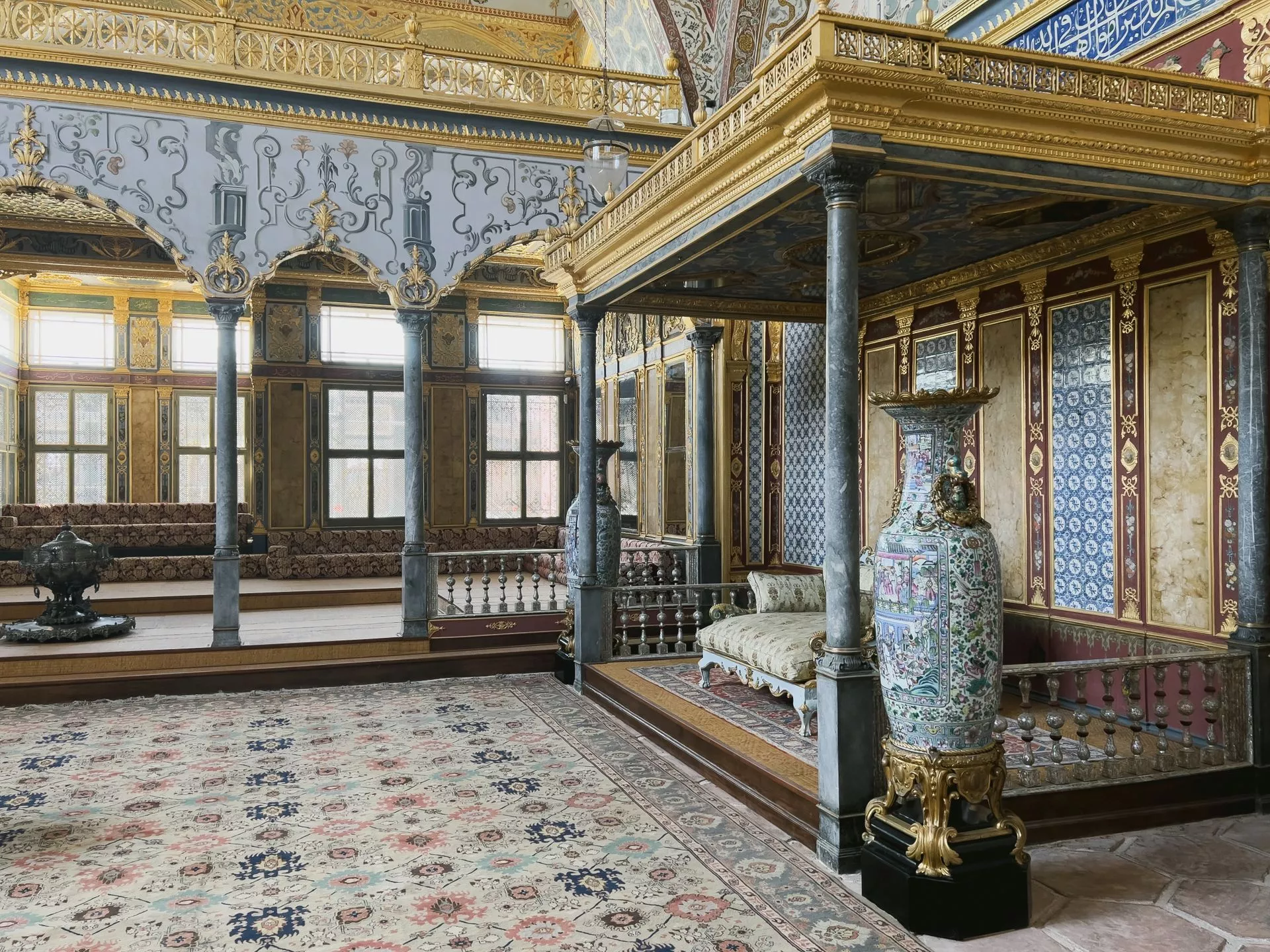
The contrast with Topkapı the day before is the whole point. Topkapı is medieval-Ottoman pavilions stepped into garden courtyards. Dolmabahçe is European-Baroque excess on a single waterfront axis — the crystal staircase, the four-and-a-half-tonne chandelier from Queen Victoria in the Ceremonial Hall, the gold-leaf surface area measured in kilograms. Visits are guided-route only; budget 90 minutes minimum.
Day 2 Evening: Private-Table Bosphorus Dinner Cruise from Kabataş (8:15 pm – 11:00 pm)
Dolmabahçe's exit gate is a 5-minute walk along the Bosphorus to Kabataş port, where the private-table dinner cruise boards. Boarding usually opens around 7:30 pm with departure at 8:15 pm; the boat returns to dock around 11:00 pm. The route loops between the European and Asian shores, passing every landmark you've seen by day re-lit at night.
Why a private-table cruise rather than a shared-bench tourist boat: your own seating, a fixed Turkish menu served course by course, and an unobstructed Bosphorus view that doesn't disappear behind a crowd phone-screen wall every time something interesting passes. The shows on board run between courses — Turkish folk dance, a whirling dervish segment (different from the full Sema you saw on Day 1), belly dance, often a live percussion or DJ set on the way back to port.
What you actually see from the deck: Dolmabahçe Palace lit up from the water at the start, Ortaköy Mosque under the 15 July Martyrs Bridge, the wooden yalı mansions of the Asian shore, Maiden's Tower mid-strait, the Galata Tower silhouette on the way back to port. Dress code is smart-casual; flag dietary needs at booking; expect a three-hour window door-to-door. Tap the dinner-cruise card on the Stadtly map for the live booking link and the day's exact departure.
Practical Survival Guide: Tickets, Closing Days, Dress Code, Transport
Five things decide whether your 48 hours runs smoothly. None of them are complicated; all of them are easy to forget under jet lag.
- Buy an Istanbulkart on arrival. A blank card costs 165 TL at the airport vending machines (early 2026), then a single tram ride is 42 TL with the card versus more than double without it (The İstanbul Insider, İstanbul Kart: How to Get & Use It, 2026). For this 2-day plan, you'll use it on the airport metro in and out, two T1 tram rides in the city, and the optional Tünel funicular. Load 300 TL.
- Pre-book the big-ticket sights via the attraction cards. Topkapı combined ticket runs around 2,750 TL in 2026, Dolmabahçe combined around 2,000 TL, Hagia Sophia €25, Galata Tower and the HodjaPasha Sema and the dinner cruise are all bookable from the same map. Every attraction in the Stadtly itinerary links straight to its official sales page — you book once, and the route stays in sync.
- Memorise the four-closure table. Topkapı Tuesdays. Dolmabahçe Mondays. Grand and Spice Bazaars Sundays. Hagia Sophia tourist-closed Fridays 12:00–14:30. A Wednesday-or-Thursday start hits every sight at full hours.
- Dress for the mosques once. Long trousers or a long skirt, covered shoulders, headscarves for women — provided free at the entry of every mosque. Wear shoes you can slip on and off; you'll do this several times each day.
- Plan around prayer times. Mosques close to visitors during the five daily prayers (each roughly 30 minutes). The midday Dhuhr around 12:30 in May is the only one that bites this plan — which is why Day 1 morning starts at the Blue Mosque at 9:00.
The transit math 2-day visitors miss: because Day 1 is fully walking and Day 2 uses one tram stop, your in-city transit cost across 48 hours is under €5 with the Istanbulkart. Most İstanbul guides assume you're crossing the city six times a day from a Beyoğlu base. Stay in Sultanahmet for Night 1 and the budget collapses.
Build Your Own Version of This Itinerary on Stadtly
This 48-hour plan is a reference loop, not a script. Stadtly lets you open the same map, drag stops in or out, swap any block for a different attraction, and export the result to PDF before you fly. The point of the platform is your version, not ours.
Three easy variations on the same two days. A slower-paced 48 hours drops Dolmabahçe and gives Beyoğlu an extra afternoon for coffee, a hammam, and an Istiklal walk. A food-leaning 48 hours swaps two of the museums for a cooking class and a food walk around Karaköy. A culture-heavy 48 hours adds Süleymaniye Mosque before the bazaars and Chora Church on the way back, and shifts dinner to Galata. All three start from this itinerary as the base layer.
If you're already certain you want a longer trip, the same Stadtly account holds your future 3-day and 4-day routes side by side. Duplicate this one, extend it, and you're not starting from a blank map.
Frequently Asked Questions
Is 48 hours enough time in İstanbul?
For first-timers, yes — for the headline sights of both the historic peninsula and the Bosphorus side, two days hits the sweet spot. You'll skip the Asian side, the Princes' Islands, and a full Bosphorus day-cruise, but you'll see Sultanahmet, the bazaars, Galata, Beyoğlu, Dolmabahçe, and the Bosphorus at night without rushing.
What's the best 2-day İstanbul order — Sultanahmet first or Beyoğlu first?
Sultanahmet first. The historic peninsula's biggest sights (Hagia Sophia, Topkapı) need clear morning energy and walk-in light, and a Bosphorus dinner cruise is the natural Day 2 closer rather than something to slot mid-day. Starting in Sultanahmet also lets you sleep at the base of Day 1's loop.
Do you need to book Topkapı, Hagia Sophia and Dolmabahçe tickets in advance?
Yes for all three in peak season (May–October). The attraction cards on the Stadtly map link straight to the official booking pages, so you can book all three from the itinerary in one sitting. The Topkapı combined ticket sits around 2,750 TL (The İstanbul Insider, 2026) and the on-site queue can run 40 minutes in summer.
Can you walk between Sultanahmet and Beyoğlu / Galata?
Yes. Crossing the Galata Bridge from Eminönü to Karaköy takes 10–15 minutes on foot, and the whole Day 2 morning from Grand Bazaar to Galata Tower is walkable in well under 90 minutes including the bazaar visits. Only the Karaköy → Kabataş leg for Dolmabahçe uses one short T1 tram stop, about 5 minutes.
What's the best Bosphorus cruise for first-time visitors with only 48 hours?
A private-table dinner cruise departing Kabataş around 8:15 pm. It doubles as your Day 2 dinner and your Bosphorus tour in the same three-hour window, so you don't lose half a day to a separate daytime ferry. The route passes Dolmabahçe, Ortaköy Mosque, Maiden's Tower, and Galata Tower lit up at night.
Which days should you avoid for a 2-day İstanbul trip?
Avoid landing on a Monday (Dolmabahçe closed), a Tuesday (Topkapı closed), or a Sunday (Grand and Spice Bazaars closed). A Wednesday-to-Friday block is the easiest — every sight on this itinerary is open on at least one of those days, and the Hagia Sophia Friday lunch closure is a 2.5-hour window you can plan around.
Plan This 48-Hour Trip in Stadtly
Twelve landmarks, one tram stop, two walking days that finish on the same Bosphorus from opposite sides. Day 1 is the Ottoman-Byzantine peninsula on foot, with the Sema at HodjaPasha as the closer. Day 2 is the bazaars, Galata, Beyoğlu, the waterfront, and a private-table dinner cruise from Kabataş. Every stop is on the same Stadtly map — open it on your phone, edit as the days shift, save it offline before you fly, and share the link with whoever you're travelling with.
👉 Open the full 48-hour route on Stadtly.
👉 Or build your own version: 48-hour route on Stadtly — duplicate this itinerary and remix it stop by stop.
Travelling with even less time? İstanbul in 24 Hours: The Essential One-Day Itinerary is the same Day 1 loop compressed into a single day. Travelling with more? A third day belongs on the Asian side — Kadıköy, Üsküdar, and a Bosphorus ferry from Eminönü to Beylerbeyi Palace.
Sources
- Hürriyet Daily News, İstanbul welcomed more than 18 million visitors last year, retrieved 2026-05-22, https://www.hurriyetdailynews.com/istanbul-welcomed-more-than-18-million-visitors-last-year-205331
- Daily Sabah, 21 million visit Türkiye's Hagia Sophia Grand Mosque since reopening (13.6 million visitors in 2022), retrieved 2026-05-22, https://www.dailysabah.com/turkiye/istanbul/21-million-visit-turkiyes-hagia-sophia-grand-mosque-since-reopening
- Time Out, Turkey introduces €25 fee to visit the Hagia Sophia Grand Mosque, retrieved 2026-05-22, https://www.timeout.com/news/tourists-will-now-have-to-pay-25-to-visit-this-iconic-european-attraction-011724
- Türkiye Today, İstanbul's Basilica Cistern: Ancient marvel, modern exhibition site (2020–2022 restoration; 1,440 m³ concrete and 1,600 m³ sediment removed), retrieved 2026-05-22, https://www.turkiyetoday.com/culture/istanbuls-basilica-cistern-ancient-marvel-modern-exhibition-site-32770/
- GoTürkiye, İstanbul's Grand Bazaar hosts almost 40 million visitors in 2022 (39.77 million visitors; ~2,500 shops; restoration completed 2021), retrieved 2026-05-22, https://branding.goturkiye.com/istanbuls-grand-bazaar-hosts-almost-40-million-visitors-in-2022
- The İstanbul Insider, Entrance fees of İstanbul's main tourist attractions in 2026 (Topkapı combined ticket ~2,750 TL), retrieved 2026-05-22, https://theistanbulinsider.com/entrance-fees-of-istanbuls-main-tourist-attractions/
- The İstanbul Insider, İstanbul Kart: How to Get & Use It (2026 Guide) (blank card 165 TL; tram single 42 TL), retrieved 2026-05-22, https://theistanbulinsider.com/how-to-get-an-istanbul-kart-and-is-it-worth-it/
- Istanbul Tourist Information, Dolmabahçe Palace Visitor Guide 2026 — Tickets, Hours & Tips (combined ticket ~2,000 TL covering Selamlık + Harem + Painting Museum), retrieved 2026-05-22, https://istanbul-tourist-information.com/dolmabahce-palace-visitor-uptade/
- Hodjapasha Culture Center, History (built on the site of the 15th-century Hocapaşa Hamamı, reign of Sultan Mehmed II; restored and opened as a culture center in 2008), retrieved 2026-05-22, https://hodjapasha.com/en/history/
- UNESCO Intangible Cultural Heritage, Mevlevi Sema ceremony (inscribed on the Representative List of the Intangible Cultural Heritage of Humanity in 2008; Mevleviye order founded in Konya in 1273), retrieved 2026-05-22, https://ich.unesco.org/en/RL/mevlevi-sema-ceremony-00100
- Galataport, Wikipedia (first ship docked October 2021; 1,200 m of shoreline; 29,000 m² underground cruise terminal — the world's first), retrieved 2026-05-22, https://en.wikipedia.org/wiki/Galataport
Planning a trip to Istanbul?
Discover attractions, hotels and tours to build your perfect itinerary.
Explore Istanbul