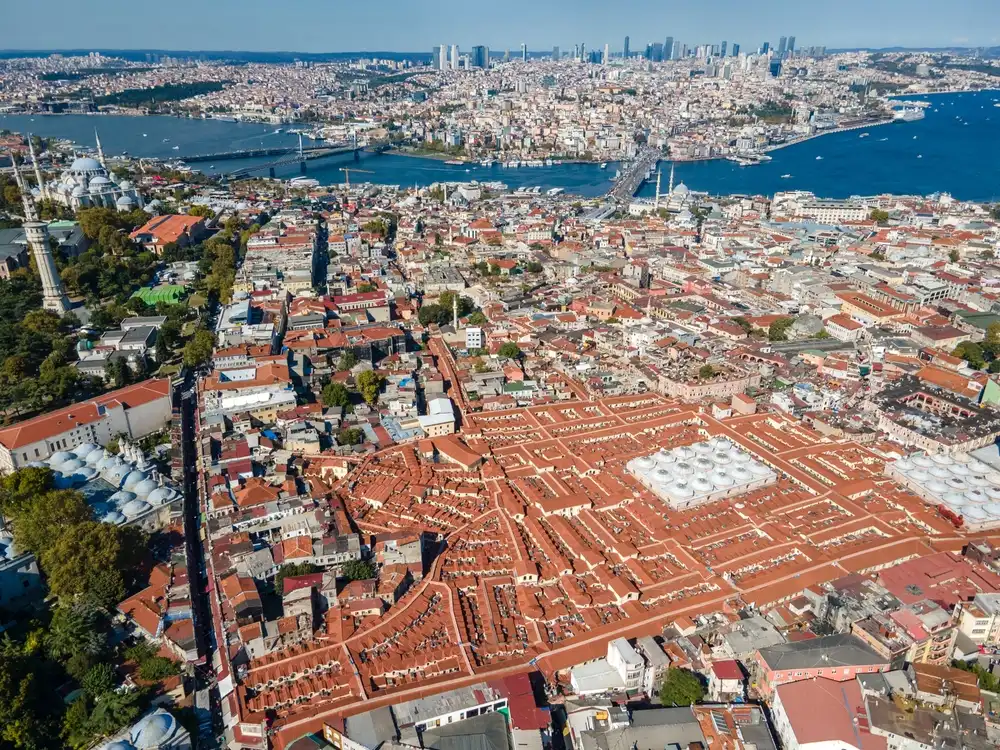
The Grand Bazaar: A Survival Guide to Shopping in 4,000 Shops (2026)
The 2026 survival guide to İstanbul's Grand Bazaar — 4,000 shops, the four gates that matter, what to buy, what to skip, and how to haggle without overpaying.
İstanbul's Grand Bazaar is a 567-year-old covered city with roughly 4,000 shops, 22 gates, 61 numbered streets, and somewhere between a quarter and four hundred thousand visitors a day depending on the season. Most first-time visitors walk in through the nearest gate, get visually overwhelmed within ten minutes, buy something they didn't plan to buy at a price they later regret, and leave through a different exit than the one they came in by. This guide is for everyone who would prefer not to do that.
The Bazaar rewards a small amount of preparation. Know which of its 22 gates actually matter. Know which categories of goods are genuinely worth Bazaar prices, and which are markup on commodity goods you can buy cheaper three streets away. Know the haggling ratios — opening asks are typically two-and-a-half to three times the seller's walk-out price, and a fair close lands around fifty to sixty percent of the original. Do that, and the place stops being a sensory ambush and starts being a coherent shopping environment with a 1,500-year retail tradition behind it.
Key Takeaways
- The Grand Bazaar (Kapalıçarşı) is a 15th-century covered marketplace with roughly 4,000 shops across 61 streets and 22 gates, founded by Mehmed II between 1455 and 1461 (UNESCO World Heritage Centre, Historic Areas of Istanbul, 1985).
- It is open Monday through Saturday from 09:00 to 19:00 and closed Sundays and on the first day of religious holidays. Entry is free; you only pay for what you buy.
- The productive shopping window is Tuesday or Wednesday between 10:30 and 12:30 — late enough that all shutters are up, early enough that the cruise-ship groups have not arrived.
- Eight categories are genuinely worth Bazaar prices: gold and silver, hand-knotted carpets, copper and brass, ceramics, leather, glass mosaic lamps, calligraphy, and meerschaum pipes. Nearly everything else is cheaper elsewhere in Sultanahmet.
- Opening prices typically sit at two-and-a-half to three times the walk-out price. A reasonable close lands between 50% and 60% of the original ask after tea and a few rounds of conversation.
The Grand Bazaar at a Glance
The Grand Bazaar — Kapalıçarşı in Turkish, literally "Covered Market" — is a 15th-century roofed marketplace at the top of İstanbul's historic peninsula. The Türkiye Ministry of Culture and Tourism lists it with roughly 4,000 shops on 61 covered streets, employing some 26,000 people across the broader complex. On a busy summer day the area handles between 250,000 and 400,000 visitors, which is why it routinely ranks among the most-visited single attractions on Earth.
It sits in the Beyazıt–Çemberlitaş quarter, a 12-minute downhill walk from Hagia Sophia and a five-minute uphill walk from the Spice Bazaar. The Beyazıt–Kapalıçarşı stop on the T1 tram line drops you at the western gate. Entry is free at all 22 gates. There is no ticket, no bag fee, and no contractual obligation to buy — the only money you spend is on what you choose to leave with, and on the small glasses of çay that shopkeepers will keep handing you whether you ask for them or not.
This guide is written for visitors who plan to actually buy something rather than only photograph the arches. The Bazaar makes a fine architectural visit on its own — its central İç Bedesten is one of the oldest pieces of standing Ottoman civic architecture in the city — but it makes a better visit if you understand it as a working trade environment rather than a museum. If the Bazaar is one stop on a tight schedule, our one-day İstanbul walking plan slots it as the late-afternoon anchor, after the Sultanahmet monuments have closed for the day.
A Five-Century Marketplace: How the Bazaar Got Here
Construction of the Grand Bazaar began under Mehmed II shortly after the 1453 conquest of Constantinople. The core İç Bedesten — sometimes called the Old or Cevahir Bedesten — was completed around 1461 as a fortified warehouse for textiles and jewellery, designed with thick stone walls and lockable gates because the goods inside were too valuable to leave unguarded after dark. Revenue from the rents was earmarked for the upkeep of the newly converted Hagia Sophia, which then operated as Mehmed's principal mosque.
Over the following four centuries the complex grew outward. The Sandal Bedesten was added in the 16th century for the silk and fine textile trade. The streets between the bedestens were gradually covered with vaulted roofs to protect the goods and the merchants from sun and rain. From the late 16th century onward, sultans and their viziers commissioned the peripheral hans — Zincirli Han, Cebeci Han, Çuhacı Han, Astarcı Han — as combined caravanserai, workshop, and residential complexes around the perimeter, integrated into the bazaar via internal gates.
Disaster shaped the building as much as commerce did. Major fires swept through in 1546, 1618, 1701, 1750, and again in 1894, and the 1894 İstanbul earthquake caused the most recent serious structural damage. Each rebuild preserved the street grid and the trade-cluster logic, which is why the bazaar's layout has remained recognisable for four centuries. The most recent significant intervention was a 2014 restoration of the roof and around 80 of the most damaged domes, led by the İstanbul Metropolitan Municipality (İBB) with backing from the Türkiye Ministry of Culture.
The trade-guild legacy still organises the floor. Jewellers cluster around the İç Bedesten. Carpet dealers line Halıcılar and Yağlıkçılar streets. Leather shops concentrate toward the south. The book market (Sahaflar Çarşısı) is reached through its own side gate next to the Beyazıt Mosque. None of this is signposted in English, but once you know the streets are organised by trade, the building stops being a maze and starts being a directory.
How the Bazaar Is Laid Out: Gates, Streets, Hans, Bedestens
The Grand Bazaar has 22 gates, 61 numbered interior streets, and two original bedestens at its core. Practically speaking, only four of those gates matter: Beyazıt Kapısı on the west, Nuruosmaniye Kapısı on the east, Çarşıkapı on the north, and Mahmutpaşa Kapısı (also northern) opening downhill toward the Spice Bazaar. Pick your gate based on what you came for, not which one is closest to your taxi.
Beyazıt Kapısı is the default first-timer entrance. It sits next to the Beyazıt–Kapalıçarşı tram stop, opens directly onto Kalpakçılar Caddesi — the bazaar's main jewellery street — and is the busiest of the 22. Use it if you have no other plan. Nuruosmaniye Kapısı on the east side is the architectural showpiece: a Baroque-period 18th-century gate that opens onto the Nuruosmaniye Mosque courtyard. It is the right gate to enter if you are walking down from Sultanahmet, and the right gate to exit if you intend to continue toward Çemberlitaş or the tram.
Çarşıkapı — literally "the gate of the bazaar" — is the northern entrance from the Çemberlitaş tram stop, the gate most locals use, and the quietest of the four. Mahmutpaşa Kapısı is the working-İstanbullu exit on the north side, opening onto Mahmutpaşa Yokuşu, the dense shopping street that runs steeply downhill to the Spice Bazaar at Eminönü. Exit through Mahmutpaşa if you want to continue your morning through the bazaar quarter rather than treating the Grand Bazaar as a standalone visit.
Inside, the two bedestens are the navigational anchors. The İç Bedesten (Cevahir Bedesten) is the original 1461 core, now home to antique dealers, the highest-grade jewellery, and the small auctions held mid-morning on weekdays. It locks at night behind its own gates. The Sandal Bedesten to its east was built in the 16th century for the silk trade and now mixes antiques with mid-range jewellery. The hans wrap the perimeter — Zincirli Han is the most photographed (gold workshops around a small courtyard), Cebeci Han still has working silversmiths, and Çuhacı Han hides calligraphers and a handful of stubborn old-school bookbinders.
The orientation trick that works on every visit: the bazaar runs roughly east–west, so if you keep the natural daylight from the few open courtyards on your right shoulder you are heading toward the Beyazıt (west) side; on your left, toward Nuruosmaniye (east). It is more reliable than your phone, which loses signal under the domes.
The Eight Things You're Actually Here to Buy
Most of the inventory at the Grand Bazaar is mass-produced commodity goods sold at a tourist markup. But eight categories still carry genuine craft value, and these are the ones it is worth paying Bazaar prices for: gold and silver jewellery, hand-knotted Turkish carpets and kilims, copper and brassware, ceramic Iznik-style tiles and bowls, leather goods, glass mosaic lamps, calligraphy and miniatures, and meerschaum pipes. Everything else is markup on something you can buy more cheaply elsewhere.
Gold and silver jewellery. Gold in Türkiye is sold by weight against the daily gold-rate fix, which any reputable shop will display on a small electronic board behind the counter. The price you pay is the weight in grams multiplied by the day's rate plus a workmanship margin — typically 15% to 25%, depending on the design and the shop. The workmanship margin is where you negotiate. The weight and the daily rate are not negotiable. If a shop refuses to break the price down into weight and rate in front of you, walk.
Hand-knotted Turkish carpets and kilims. The single most expensive thing you can buy in the Bazaar, and the most heavily counterfeited. A real hand-knotted carpet has visible knots on the back, not a machine-woven seam. Natural dyes will bleed slightly onto a damp white cloth — that's a feature, not a flaw. Hereke silk carpets and high-grade Kayseri wool carpets come with certificates of origin; if there is no certificate, treat the carpet as good wool from somewhere generic rather than a named workshop. Expect to spend at least 90 minutes on a serious carpet purchase, most of it drinking tea.
Copper and brassware. Turkish coffee pots (cezve), serving trays, hammered platters. The single useful test is whether the interior of any cooking vessel is tin-lined — silver-coloured on the inside. Untinned copper reacts with food. The shops on the south side of the bazaar near Bakırcılar are the working copperware district.
Ceramic tiles and bowls. True Iznik tiles, painted using the 16th-century underglaze technique, cost hundreds of euros for a single piece and are mostly sold in the İç Bedesten antiques quarter. What is sold to most tourists is Kütahya-made ceramic — perfectly good craft, often very pretty, but a different product with a different price. Hand-painted Kütahya pieces have slight asymmetry and a workshop signature on the unglazed base. Machine-printed transfers are uniform and unsigned.
Leather goods. Jackets, bags, belts. Quality varies wildly across adjacent shops on the same street, which is unusual in the bazaar but accurate. The reliable test is to crumple a sample firmly in your hand and watch how quickly it relaxes back to its original shape. Real leather springs back within seconds; bonded leather (a glued composite) stays creased.
Glass mosaic lamps. The photogenic Ottoman-style lamps. The cheap ones have glass pieces painted onto a single dome; the real ones have individually cut glass tiles set into a metal armature, which you can see by looking at the underside.
Calligraphy and miniatures. Several working calligraphers operate from the perimeter hans, particularly Çuhacı Han. An original signed piece costs ten to fifty times what a printed reproduction does, and most general shops sell both side by side without distinguishing them. Look for a signature on the original and an embossed printing artefact on the reproductions.
Meerschaum pipes (lületaşı). Meerschaum is a soft white mineral mined almost exclusively around Eskişehir in central Türkiye, carved into ornate pipes that yellow beautifully with use. A genuine meerschaum pipe is light, slightly warm to the touch, and porous when you breathe lightly on it. Plastic imitations are heavier and cold.
The Five Things You Shouldn't Buy Here
Five categories cost more inside the Grand Bazaar than three streets away. Buy them elsewhere. The list: branded clothing (almost always counterfeit and confiscatable at EU airports), bulk spices and saffron (the Spice Bazaar is six minutes downhill and noticeably cheaper), brand-name Turkish delight in tourist tins, generic evil-eye (nazar boncuğu) trinkets, and pre-packaged Turkish coffee.
Counterfeit branded clothing. Sold openly upstairs in some bedesten-adjacent shops and in the Sandal Bedesten upper floors. The legal risk is real — EU customs routinely confiscate counterfeit goods at the border, and the labels are often clumsy enough to spot at a glance. The construction quality also gives the goods away: synthetic blends sold as wool, machine-stitched seams sold as hand-finished.
Bulk spices and saffron. The Spice Bazaar (Mısır Çarşısı) at the bottom of Mahmutpaşa Yokuşu is the city's dedicated spice market, built in 1664 specifically for this trade. Prices there are typically 20% to 40% below Grand Bazaar prices for the same product. Saffron sold by weight in any tourist market — including inside the Grand Bazaar — is the highest-risk category for adulteration; if you are serious about saffron, buy it at one of the named-brand shops at the Spice Bazaar entrance rather than at a general bazaar stall.
Brand-name Turkish delight. Hacı Bekir, Koska, and Hafız Mustafa operate their own retail stores throughout central İstanbul and at İstanbul Airport, all at standard retail prices. Bazaar shops resell the same boxes at a margin. If you want their product specifically, buy it from their own shops; if you want anonymous lokum, the Spice Bazaar undercuts the Grand Bazaar reliably.
Mass-market evil-eye trinkets. A glass nazar boncuğu costs one or two lira at any street stall in Sultanahmet. The Bazaar price for the same factory-made glass is three to five times that. There is no quality difference; the markup pays for the bazaar address.
Pre-packaged Turkish coffee. Supermarket-grade ground coffee in tourist packaging. If you want genuinely fresh coffee, the original Kurukahveci Mehmet Efendi shop at the side entrance of the Spice Bazaar grinds it to order, has done since 1871, and costs less than the bazaar equivalent. The Spice Bazaar is part of the same downhill morning loop in our 48-hour İstanbul first-timer plan, which pairs both bazaars before lunch on Day 2.
Haggling Like You Mean It: A Practical Script
Haggling at the Grand Bazaar is a structured negotiation, not a contest of nerve. The opening ask is typically two-and-a-half to three times the seller's actual walk-out price, depending on the category and how clearly tourist you read. A fair first counter-offer sits around 40% of the ask. The conversation that follows — over tea, in stages, with several rounds of "this is my final price" that are demonstrably not the final price — closes somewhere between 50% and 60% of the original ask. This range is consistent across categories with a few exceptions.
The exceptions matter. Carpets, leather, lamps, and ceramics all haggle hard — 50% to 60% off the opening ask is realistic on a real purchase. Gold and silver, because they are weight-priced against a daily rate, haggle softly — you negotiate the workmanship margin (15% to 25%) downward by perhaps a quarter of itself, not the whole price. The book market at Sahaflar Çarşısı does not haggle in any meaningful sense. Small fixed-price food, sahlep stands, and the restaurants on the bazaar perimeter do not haggle either.
The negotiation itself has a recognisable five-line shape. You open by expressing genuine interest in one specific item — not gestural browsing. The seller names a price; you absorb it without reaction and either name a counter-offer with a brief reason ("I've been quoted X across the Egyptian Bazaar for similar," or simply, "That's outside my budget by half") or ask for a "best price" if you genuinely do not know the range. The seller's first response is almost always the "family business, my cost, I'd lose money" line — this is the social opening, not the actual position. You acknowledge it warmly and either move up slightly or hold and say nothing for a few seconds. After two or three exchanges the real number arrives.
Tea is the structural pause. Accepting a glass of çay is not a commitment to buy anything, and walking away after tea is normal and expected. What it does is reset the rhythm — both you and the seller stop bargaining and just talk for two minutes, which makes the next round less adversarial. The Kapalıçarşı Esnafları Derneği, the bazaar's tradesmen's association, has been clear in its public communications that this is standard hospitality; you are not under obligation.
Cash matters. Most shops accept Visa and Mastercard, euros, US dollars, and Turkish lira, but cash payments typically earn a 5% to 10% discount over card because the seller skips the processing fee. Bring lira if you can, because the seller's daily euro-to-lira and dollar-to-lira rates are rarely the best ones available. For larger purchases — carpets above a few thousand euros, fine jewellery — agreeing the price in lira and paying in lira is the strongest negotiating position.
The phrase "this is my final price" is almost never your seller's final price the first time it is uttered. It usually appears two or three times in a normal negotiation. The genuinely final price arrives when you have your hand on the door handle and have already half-walked out. If they call you back, the number you hear next is closer to truth than anything that came before it.
Spotting the Tourist Traps: How to Know Real Quality
Three quick tests separate genuine Grand Bazaar craft from the souvenir-stall version of the same goods. Rub a damp white cloth on a carpet pile to test for natural dyes — a slight colour bleed is good, it means the dyes are plant-based rather than chemical. Hold a "silver" item against a magnet — sterling silver is not magnetic, but cheap plated alloys with a steel core are. Check whether a ceramic piece has a flat unglazed base signed by a workshop (hand-painted) or a printed transfer pattern (mass-produced).
Carpets. The knot count visible on the back of the rug is the headline quality marker — the more knots per square centimetre, the finer the weave and the higher the value. Genuine Hereke and Kayseri carpets carry certificates of origin from registered workshops, which the seller should produce without being asked twice. The natural-dye bleed test is the fastest fraud check; a chemical-dyed rug runs colour aggressively when rubbed with a damp cloth, while a natural-dye rug bleeds faintly or not at all. Ask which knot is used — the Turkish (Gördes) double knot is standard for Anatolian rugs, the Persian single knot for imports.
Silver jewellery. The 925 hallmark stamped on the back of the piece is the European standard for sterling silver — 92.5% pure silver, 7.5% other metals. The magnet test catches the most common counterfeits because cheap plated jewellery uses a magnetic steel base. Sterling silver also feels denser than plated alloy at the same size. Reputable shops will engrave or stamp the hallmark in front of you on bespoke pieces.
Gold jewellery. Türkiye's domestic gold market is heavily weighted toward 22-karat work, though 18-karat and 14-karat are also available. The daily gold-rate fix is published by Türkiye's banks and is visible on the seller's display board behind the counter; you can also pull it up on your phone in three seconds. The seller calculates total price as weight × rate × karat purity, plus the workmanship margin. If they refuse to show the calculation in front of you or skip past one of the components, walk out. There is no excuse for opacity in a weight-priced product.
Ceramics. Hand-painted pieces have slight asymmetry, visible brush marks on the surface, and a workshop signature on the unglazed footprint of the base. Mass-produced transfer-printed pieces are machine-perfect, identical across multiples, and unsigned. The price difference is typically four to ten times the printed-equivalent price, which is reasonable given the hours of work involved.
Leather. The crumple test is the headline check; real leather springs back within seconds, bonded leather stays creased. The stitching is the second check — densely sewn (more than eight stitches per inch) suggests genuine workshop quality, while loose machine-stitching at four or five stitches per inch is a mass-production tell. The smell is the third check; real leather smells like leather, while bonded leather smells faintly chemical.
The "antique" question is where most uninformed visitors lose money. Most "Ottoman antiques" in the Grand Bazaar are reproductions made in the past decade in Turkish or Iranian workshops, and they are perfectly acceptable as decorative objects at decorative-object prices. Genuine antiques more than 100 years old are legally subject to an export permit from the Türkiye Ministry of Culture, and almost no Bazaar shop will arrange one because the paperwork is genuinely difficult. If a seller insists a piece is a genuine 200-year-old Ottoman antique but cannot or will not arrange an export permit, the piece is almost certainly a reproduction.
The most common Grand Bazaar pivot is the brother-in-law manoeuvre: you express interest in something modest, and within two minutes the seller is leading you to "his brother's carpet shop just two doors down" to see something larger and more expensive. This is the textbook pivot, used thousands of times a day. You are not obliged to follow. The same authenticity-versus-reproduction question that shapes how you read these shops also shapes how you read the Byzantine mosaics covered in our definitive Hagia Sophia guide next door — the answer in both buildings is "look for the workshop signature."
Planning Your Visit: Hours, Gates, Best Times, What to Bring
The Grand Bazaar is open Monday through Saturday from 09:00 to 19:00 and closed entirely on Sundays. It also closes on the first day of Ramazan Bayramı (Eid al-Fitr) and the first day of Kurban Bayramı (Eid al-Adha), with reduced trading on the remaining bayram days. The bayram dates shift each year on the lunar calendar, so confirm against the Türkiye Ministry of Culture's official Kapalıçarşı page before you travel.
The productive shopping window is Tuesday or Wednesday between 10:30 and 12:30. By 10:30 every shutter is up, the morning deliveries have cleared the alleys, and the shopkeepers are still in the mood for a real conversation rather than a sales sprint. By 12:30 the lunchtime tour groups start arriving and the volume becomes unpleasant. The second-best window is 16:00 to 18:00, after the day's group tours have left and before the 19:00 closing — you get more attention from sellers, but slightly less inventory because the gold counters often pack up first.
The worst days are predictable. Saturday is the busiest combined day of the week because local İstanbullular shop alongside cruise-ship arrivals and weekend tourists. Friday is fine for the Bazaar itself but tricky for the surrounding mosques and the nearby Süleymaniye, which close to visitors during the Cuma prayer between roughly 12:00 and 14:30. Sunday is closed. Avoid arriving on the day a major cruise ship docks at Galataport, which generally produces a Friday-or-Saturday-morning surge through the Beyazıt gate.
Off-season is dramatically more pleasant. November, February, and early March bring colder weather and lower foot traffic; the bazaar is half its summer volume and shopkeepers have time for real conversations. The peak European city-break months — late April to early June, and September to mid-October — produce the densest crowding. If you can choose your travel month, the off-season trade-off is worth making for a serious shopping visit.
Practical packing: bring a reusable shopping bag (most shops give thin plastic), some Turkish lira in cash for small discounts on the day's first or last purchase, a downloaded offline map of central İstanbul (mobile signal under the domes is patchy at best), and small change for the public toilets (typically 5 to 10 lira). Do not bring large rolling suitcases; the streets are narrow and the wheels jam on the cobblestones. Do not wear an expensive camera around your neck; pickpocketing exists, it is opportunistic rather than violent, and a front trouser pocket solves the problem.
The bazaar is accessible to wheelchairs and strollers on most main streets, which are flat and paved. The hans and the bedestens involve a few steps; the Nuruosmaniye gate has the gentlest grade if you need it. There is no dress code at the Grand Bazaar itself — it is a shopping arcade, not a mosque — but modest dress is sensible because the surrounding quarter includes Süleymaniye Mosque and the New Mosque, both of which apply the standard Turkish mosque dress code (covered shoulders, knee-length or longer, scarves for women in the prayer hall).
The Bazaar Quarter in 90 Minutes: Spice Bazaar, Süleymaniye, Eminönü
The Grand Bazaar sits at the top of a coherent walking quarter that continues downhill toward the Golden Horn. Within 90 minutes of exiting the Mahmutpaşa gate you can walk down Mahmutpaşa Yokuşu, detour uphill to Süleymaniye Mosque, browse the Spice Bazaar, and reach Eminönü Square at the foot of the Galata Bridge — all on a continuous downhill route with no metro or taxi required.
Mahmutpaşa Yokuşu is the working İstanbullu shopping artery that connects the Grand Bazaar's Mahmutpaşa gate to the Spice Bazaar. It is steeper, narrower, denser, and considerably cheaper than either bazaar at the ends — local families come here for fabric, household goods, and wholesale lots that no tourist ever sees. Walk it slowly; the second-floor windows tell you what kind of trade has occupied each building for the past century.
Süleymaniye Mosque is Mimar Sinan's mid-16th-century masterpiece and the most architecturally accomplished mosque in the city. It is a five-minute uphill detour from the top of Mahmutpaşa, free to enter outside prayer times, and quieter than the Blue Mosque because it is harder to find. The terrace at the rear of the courtyard delivers the best free view of the Golden Horn in central İstanbul, particularly at sunset.
The Spice Bazaar (Mısır Çarşısı) is the L-shaped Egyptian Bazaar, built in 1664 by Hatice Turhan Sultan to fund the adjoining New Mosque (Yeni Cami). It is smaller than the Grand Bazaar — roughly 85 shops to the Grand Bazaar's 4,000 — and explicitly organised around spices, dried fruit, Turkish delight, and lokum. The side entrance opens onto the original Kurukahveci Mehmet Efendi coffee shop, in continuous operation since 1871 and reliably the best place in the city to buy fresh-ground Turkish coffee at standard prices.
Eminönü Square is the Golden Horn waterfront — the ferry terminals to Üsküdar and Kadıköy, the fish-sandwich (balık ekmek) boats moored along the seawall, and the constant crush of commuters changing between tram, ferry, and bus. The square is touristy and slightly chaotic; the balık ekmek boats are nonetheless a genuinely good lunch for 100 to 150 lira.
The Galata Bridge is the two-level pedestrian-and-tram bridge across the Golden Horn, with restaurants on the lower deck and fishermen lining the railings of the upper deck at all hours. Crossing it is the natural pivot if you are continuing toward Galata Tower or Karaköy next. Every attraction in this quarter is built into our Stadtly İstanbul itineraries — open the map, see the walking paths, save it for offline.
If you are trying to combine the Grand Bazaar with this whole bazaar-quarter loop in a single morning, our İstanbul 24-hour walking itinerary sequences them in walking order with the prayer-time buffers baked in.
Fitting the Grand Bazaar Into a 1- or 2-Day İstanbul Trip
A fast walk-through of the Grand Bazaar takes 60 to 90 minutes — enough to see the architecture, the two bedestens, the gold street, and the main carpet street. A real shopping visit takes two to three hours, especially if the purchase is a carpet or fine jewellery, because tea, conversation, and several rounds of negotiation are baked into the transaction. If you intend to walk the hans (Zincirli, Cebeci, Çuhacı) on top of the main streets, allocate half a day.
On a one-day İstanbul plan, the Bazaar slots as the late-afternoon anchor between 17:00 and 18:30. By then Hagia Sophia, Topkapı Palace, and the Basilica Cistern have all closed for the day, the late sun makes outdoor sightseeing harsh, and the Bazaar is the city's most engaging covered indoor activity in the hours before sunset. The hard constraint is closing time at 19:00, so any 1-day visit needs to be in motion by 18:00 to leave enough time. Our one-day İstanbul plan blocks the Bazaar at exactly this slot for exactly this reason — every other Sultanahmet monument has closed by then, and the Bazaar becomes your evening anchor rather than a morning detour.
On a two-day plan, the Bazaar opens Day 2 in the morning. The natural rhythm is 10:00 entry through Beyazıt Kapısı, two hours inside, exit via Mahmutpaşa Kapısı, downhill through the Spice Bazaar by 12:30, lunch at Eminönü, then ferry across to Galata or up the Bosphorus for the afternoon. Our 48-hour first-timer route opens Day 2 with the Grand Bazaar at 10:00 and chains it down to the Spice Bazaar and the Eminönü ferry pier before lunch.
Repeat visitors and serious shoppers often return specifically for the hans on a third or fourth visit. The hans are where the working craftsmen still operate — silversmiths in Cebeci, calligraphers in Çuhacı, a handful of stubborn old-school bookbinders behind unmarked doors — and they reward visitors who have already absorbed the main bazaar and are ready to spend an hour looking for the workshop side of the trade. They are not on the typical first-trip itinerary, and they do not need to be.
Sunday visitors face the closure problem head-on. The Grand Bazaar is closed all day Sunday, but the Spice Bazaar is open, and the Sunday window is the best time of the week to take a Bosphorus ferry — locals are at home, the morning ferries are uncrowded, and the rhythm of a Bosphorus Sunday is the easiest version of İstanbul there is. Treat the closure as a scheduling cue, not a defeat.
👉 The Grand Bazaar is also featured in our best Instagram spots list. Check out our post to learn more.
Frequently Asked Questions
Is the Grand Bazaar worth visiting in 2026?
Yes, if you want context for what you buy or you specifically value gold, carpets, lamps, leather, or ceramics. It is less interesting if you only want generic souvenirs — those are cheaper at any Sultanahmet street stall. As a piece of living architecture and a working 500-year-old trade environment, it is worth one visit regardless of whether you intend to shop.
How much time do you need at the Grand Bazaar?
Plan 60 to 90 minutes for a fast walk-through to see the architecture, the two bedestens, and the main trade streets. Allocate two to three hours if you intend to shop seriously, especially for a carpet or jewellery purchase where tea, conversation, and negotiation are part of the transaction. Half a day if you want to see the hans as well.
What days is the Grand Bazaar closed?
The Grand Bazaar is closed every Sunday and on the first day of Ramazan Bayramı (Eid al-Fitr) and Kurban Bayramı (Eid al-Adha). Trading is reduced on the remaining bayram days. Religious-holiday dates shift each year on the lunar calendar — confirm against the Türkiye Ministry of Culture's official Kapalıçarşı page before you travel.
Do you need to haggle at the Grand Bazaar?
Yes, for almost everything except small fixed-price food, the Sahaflar book market, restaurant bills, and weight-priced gold where only the workmanship margin is negotiable. Most shops open at two-and-a-half to three times their walk-out price; a fair closing price lands between 50% and 60% of the original ask after tea and a few rounds.
Is the Grand Bazaar safe?
Yes, the Grand Bazaar is generally very safe — heavily policed, well-lit during opening hours, and crowded enough that violent crime is rare. The actual risks are opportunistic pickpocketing in dense bottlenecks and aggressive sales pressure that some visitors find tiring. Keep valuables in a front pocket, ignore the unsolicited "where are you from?" approach, and you are fine.
What's the best gate to enter the Grand Bazaar?
For first-timers, Beyazıt Kapısı on the west side is the simplest entrance because it is closest to the Beyazıt–Kapalıçarşı tram stop and opens directly onto the main jewellery street. If you are walking down from Sultanahmet, use Nuruosmaniye Kapısı on the east side, which is the most architecturally impressive of the 22 gates and opens onto the Nuruosmaniye Mosque courtyard.
Can you pay with credit cards or only cash?
Most shops accept Visa and Mastercard, as well as Turkish lira, euros, and US dollars at the seller's daily rate. Cash payments typically earn a 5% to 10% discount because the seller avoids the card-processing fee. For larger purchases — carpets, fine jewellery — paying cash in Turkish lira is the strongest negotiating position you can hold.
What should women wear at the Grand Bazaar?
There is no dress code at the Grand Bazaar itself; it is a covered shopping arcade, not a mosque. Modest casual dress (covered shoulders, knee-length or longer) is sensible because the surrounding quarter includes Süleymaniye Mosque and the New Mosque, where the standard Turkish mosque dress code applies and scarves are required inside the prayer halls.
Ready to Plan the Trip Around It
The Grand Bazaar is a destination in its own right, but it works best as one anchor in a larger İstanbul plan rather than a standalone visit. Start with our 24-hour İstanbul plan, which slots the Bazaar as the late-afternoon anchor after the Sultanahmet monuments close. Stretch it to a 48-hour first-timer route and the Bazaar opens Day 2 in tandem with the Spice Bazaar and the Eminönü waterfront. Both itineraries are mapped and editable on Stadtly. For the matching deep-dive on the building next door, see our Hagia Sophia guide.
Planning a trip to Istanbul?
Discover attractions, hotels and tours to build your perfect itinerary.
Explore Istanbul