The Hippodrome of Constantinople: A Definitive Guide to Sultanahmet Square
The definitive 2026 guide to the Hippodrome of Constantinople — chariot racing, the Nika riots, the obelisks and Serpent Column, and what to see today in İstanbul's Sultanahmet Square.
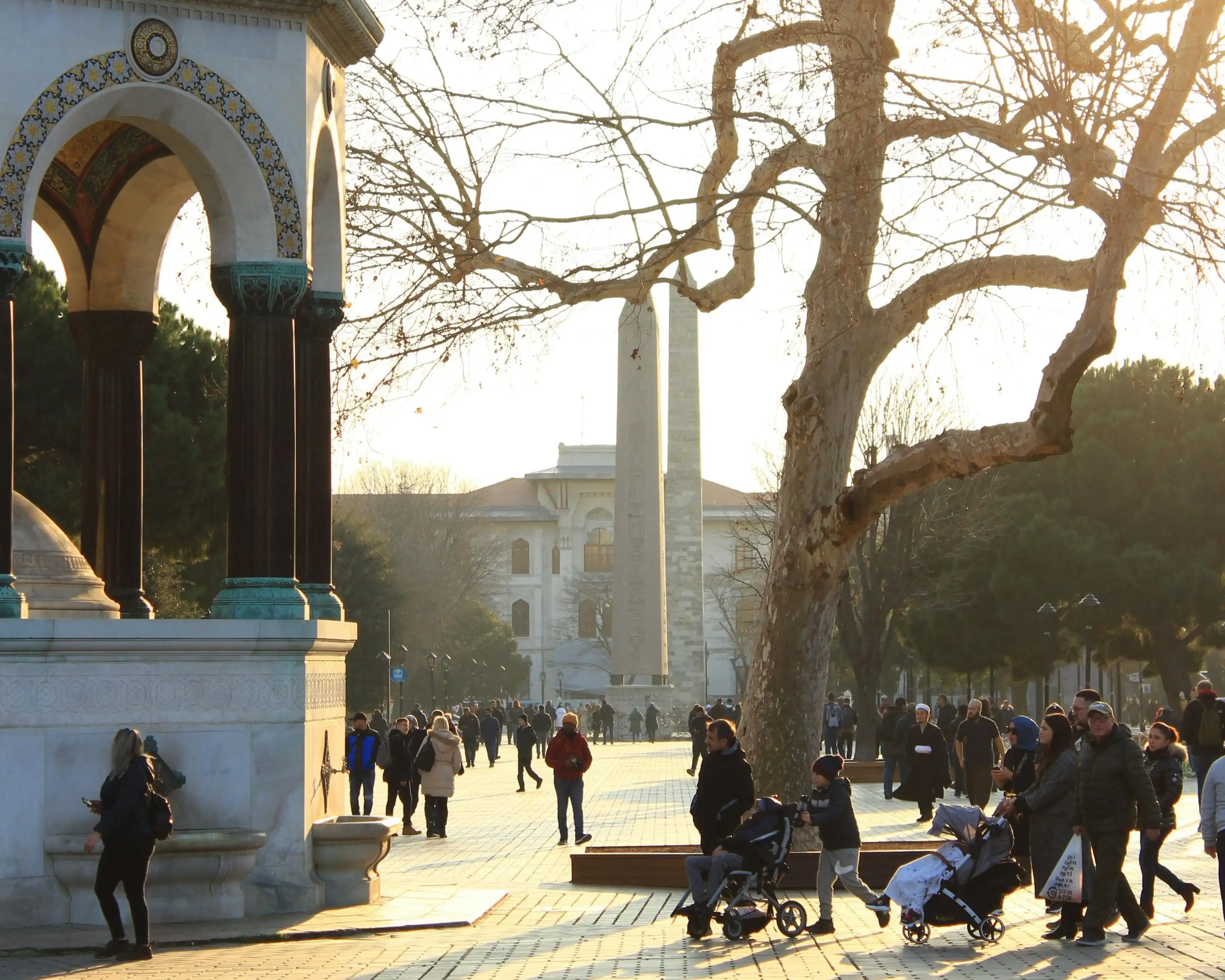
The Hippodrome of Constantinople was the Byzantine Empire's chariot-racing stadium and its de facto political arena for more than a thousand years. Today it survives as Sultanahmet Square — a free, open, ticket-free public space between the Blue Mosque and Hagia Sophia, marked by three ancient monuments and a single neo-Byzantine fountain. Most visitors cross it in fifteen minutes on the way from one mosque to the other, photograph an obelisk, and move on without realising they are standing on the most politically charged patch of ground in the medieval world.
This guide is for the visitor who wants to know what they're actually standing on. The Hippodrome rewards context more than almost any site in İstanbul precisely because so little of it is left. There is no grandstand to admire, no track to walk, no ticket to buy. What remains is an open square and four objects — and once you know that a chariot-race dispute here killed tens of thousands of people and indirectly built the Hagia Sophia next door, that a bronze column on the median was cast from melted Persian shields in 479 BCE, and that the four bronze horses now on St Mark's Basilica in Venice were looted from this exact spot in 1204, the empty square stops being empty.
Key Takeaways
- The Hippodrome was begun by the Roman emperor Septimius Severus around 203 CE and dramatically enlarged by Constantine the Great when he refounded the city as Constantinople in 324 CE.
- It held an estimated 30,000 to 100,000 spectators — ancient figures vary widely — for chariot races run by four factions, with the Blues and Greens dominant by the sixth century.
- The Nika riots of 532 CE began here over a race result, killed an estimated 30,000 people (an ancient figure reported by Procopius), and burned down the Hagia Sophia that Justinian then rebuilt into the church standing today.
- Three ancient monuments survive on the former central median: the Egyptian Obelisk of Theodosius, the bronze Serpent Column brought from Delphi, and the masonry Walled Obelisk — joined by a German Fountain gifted by Kaiser Wilhelm II in 1901.
- Now called Sultanahmet Meydanı (At Meydanı), the square is free, open at all hours, and forms one edge of the UNESCO-listed Historic Areas of İstanbul, inscribed in 1985.
The Hippodrome at a Glance: What You're Actually Standing On
The Hippodrome is not a building you enter. It is an open public square — free, unticketed, and accessible at any hour — and the long U-shaped path you walk traces the original racetrack, wrapping the central median where the monuments still stand. Three ancient monuments and one modern fountain are all that survive of a stadium that once dominated the Byzantine capital. Set that expectation before you arrive: there is no gate, no queue, and nothing to book.
The square sits in Sultanahmet, on the historic peninsula at the eastern tip of European İstanbul, directly between the Blue Mosque and Hagia Sophia. It is part of a cluster so dense that first-time visitors routinely see five major sights in a single morning — and it sits ninety seconds from the door of Hagia Sophia, whose story, as you'll see, is physically tangled up with this one.
What makes the Hippodrome worth more than a passing glance is that it was never only a stadium. For over a thousand years it was the one place where the emperor, the aristocracy, and the ordinary people of Constantinople occupied the same space at the same time. It was a racetrack, a parade ground, a venue for public celebration, and — repeatedly — the flashpoint for riots that decided who ruled the empire. The monuments on its median were trophies of conquest and diplomacy, hauled in from Egypt and Greece to dress the spine of the track. Understanding that turns a tidy modern park back into what it was: the beating political heart of Byzantium.
What the Hippodrome Was: A Roman Stadium at Byzantine Scale
The Hippodrome followed the Roman circus blueprint — a long track with a curved end, modelled on the Circus Maximus in Rome — but rebuilt at imperial scale to anchor a new capital. Septimius Severus laid out the first stadium around 203 CE, and Constantine the Great expanded it massively when he refounded Byzantium as Constantinople, a project begun in 324 CE and dedicated in 330 (World History Encyclopedia, The Hippodrome of Constantinople, 2017). From that point, the stadium and the adjacent Great Palace formed the twin centres of Byzantine power.
In plain terms, the Constantinian Hippodrome was roughly 450 metres long — some scholarly estimates run lower, closer to 400 metres — with a long oval track wrapping a central barrier called the spina, lined with obelisks, columns, and bronze statues. The curved southern end, the sphendone, was built out over a slope on enormous masonry substructures — and those substructures still stand today, visible from the street below the modern square, a detail almost every visitor walks past without noticing.
The design was political architecture. The emperor watched from the kathisma, an imperial box connected by a private passage directly to the Great Palace, so he could appear above the crowd without ever mixing with it. The races below were the public face of the regime, and the monuments on the spina were a deliberate museum of empire — antiquities imported from across the Mediterranean to show, in stone and bronze, how much of the ancient world Constantinople now claimed to inherit.
Chariot Racing and the Factions: Blues, Greens, and the Sport That Ran a City
Chariot racing in Constantinople was organised around four factions — the Blues, Greens, Reds, and Whites — named for the colours their drivers wore. By the fifth and sixth centuries the Reds and Whites had been absorbed into the two giants, and the Blues and Greens had become something between sports clubs, political parties, and organised street gangs (Smithsonian Magazine, Blue Versus Green: Rocking the Byzantine Empire, 2009). To support a colour was to take a side in city politics.
A race day ran four-horse chariots through multiple laps of the spina, launching from the carceres — the starting gates at the northern end — and whipping around turning posts at each end of the median. The factions, known as demes, were far more than fan clubs. They organised public works, maintained the city walls in wartime, voiced political demands, and could acclaim or denounce the emperor to his face from the stands. An emperor who lost the crowd in the Hippodrome was an emperor in trouble.
The drivers themselves were the celebrities of their age. The most famous, the charioteer Porphyrius, raced in the early sixth century and was honoured with commemorative monuments on the spina — unusually, for both the Blues and the Greens at different points in his career. Several of those inscribed statue bases survive and are now held in the İstanbul Archaeology Museums, a few minutes downhill behind Topkapı, where you can read the dedications to a sportsman who died fifteen centuries ago. They're among the collection highlights we flag in our guide to the best museums in İstanbul. The factional passion had a darker edge, though, and the line between a roaring sports crowd and a political mob was thin — which is exactly what snapped in 532.
The Nika Riots of 532: The Week the Hippodrome Nearly Ended an Empire
In January 532 CE, a dispute at the Hippodrome between the Blue and Green factions exploded into the Nika riots — roughly six days of revolt that nearly toppled Emperor Justinian I.). The rioters' chant, Nika! — "Conquer!" — gave the uprising its name. What began as a sporting grievance became the most dangerous week of Justinian's reign.
The trigger was a botched pair of executions that united the usually rival Blues and Greens against the emperor's administration and its unpopular officials. The two factions, normally at each other's throats, joined forces, freed prisoners, and turned on the government. Over the following days the mob burned much of the city centre — including the second Hagia Sophia — and proclaimed a rival emperor inside the Hippodrome itself. Justinian, by several accounts, prepared to flee the city.
The turning point, as reported by the contemporary historian Procopius, came when the Empress Theodora refused to run, reportedly telling the council that "the royal purple makes a fine burial shroud." The line is Procopius's reconstruction in the classical historiographical tradition rather than a transcribed quote, but the decision it describes was real: Justinian stayed. His generals Belisarius and Mundus then trapped the crowd inside the Hippodrome and slaughtered them. Procopius reports around 30,000 dead — an ancient estimate that modern historians treat with caution, since ancient casualty figures were routinely inflated, and it is hard to credit so many killed in a single enclosure in one day (World History Encyclopedia, The Hippodrome of Constantinople, 2017).
The consequence is something you can still walk into. The cathedral the rioters burned was rebuilt by Justinian into the domed masterpiece dedicated in 537 — the Hagia Sophia that stands today. The riot in this square, in other words, destroyed one church and forced the construction of the most important Byzantine building in the world. Its full story is in our complete Hagia Sophia visitor's guide, and reading the two together is the best way to understand either.
The Monuments on the Spina: A Walk Down the Ancient Median
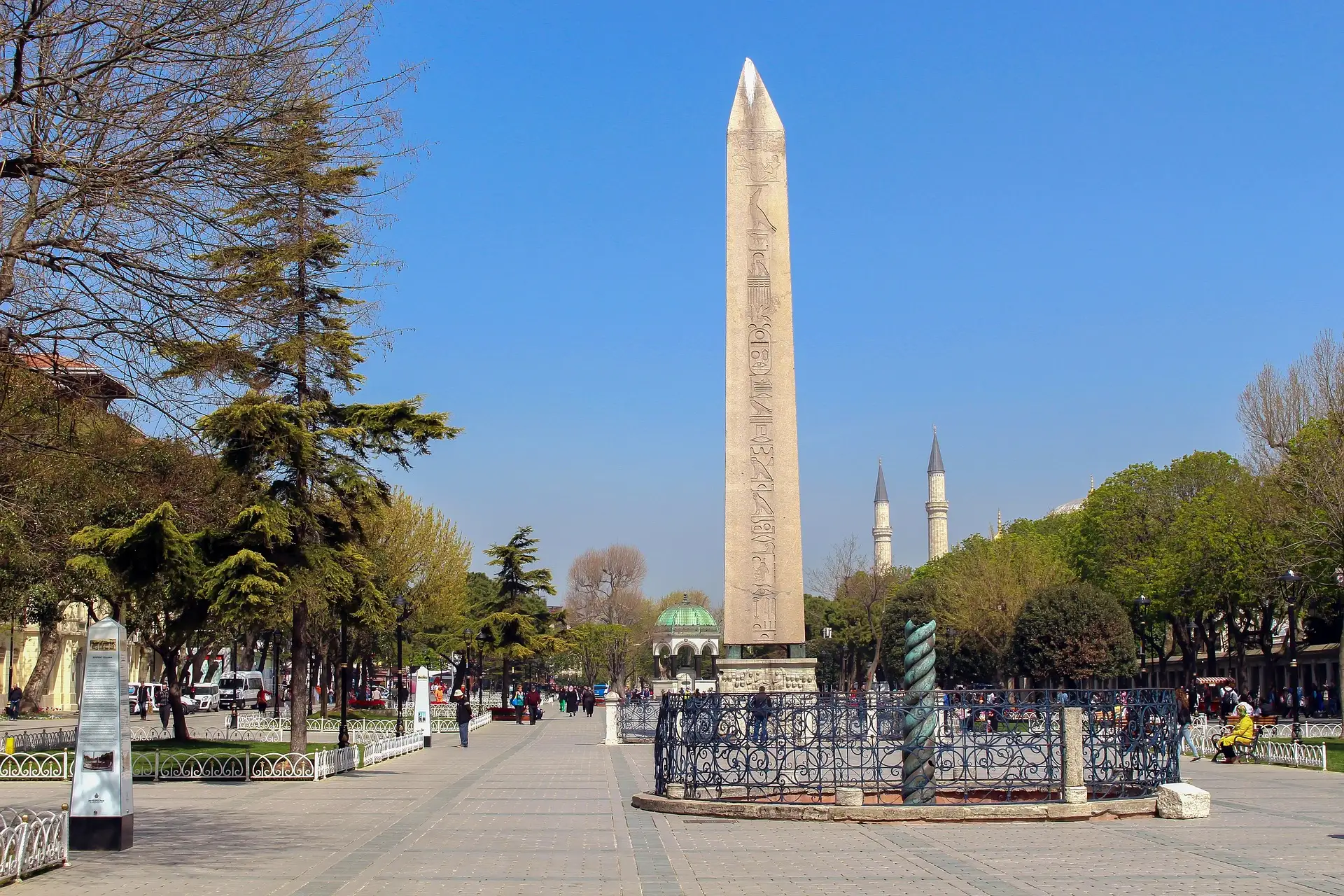
Three ancient monuments and one modern fountain survive along the Hippodrome's former central median, and together they span more than three thousand years. Walking the square from the Blue Mosque end toward Hagia Sophia, you pass them in order: the German Fountain, the Obelisk of Theodosius, the Serpent Column, and the Walled Obelisk. Each one arrived here from a different century and a different empire, which is the whole point of the spina — it was assembled as a deliberate collection of the ancient world.
The German Fountain (1901): The Modern Outlier
The German Fountain is the newest object on the square by well over a thousand years, and it makes a useful orientation marker at the northern end. Built in 1900 and inaugurated on 27 January 1901, the neo-Byzantine domed fountain was a gift from Kaiser Wilhelm II of Germany, commemorating his 1898 state visit to Sultan Abdülhamid II (Wikipedia, German Fountain, 2026). Its green dome and gold mosaic interior look ancient at a glance, which is exactly why visitors often mistake it for a Byzantine relic. It isn't — it's a piece of turn-of-the-century imperial diplomacy in disguise.
The Obelisk of Theodosius (Egyptian Obelisk): 3,500 Years Old
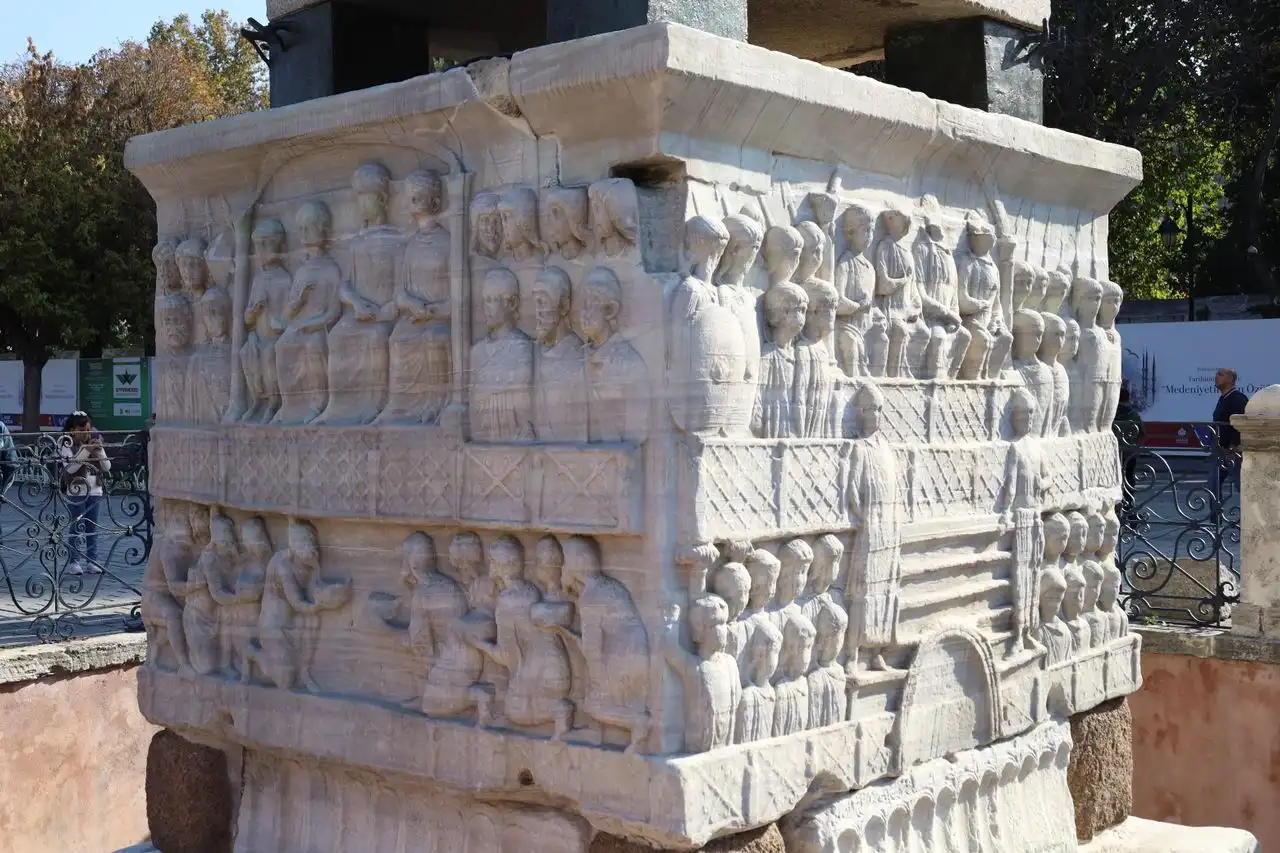
The Obelisk of Theodosius is the oldest monument in İstanbul, and it predates the city around it by nearly two thousand years. The pink-granite shaft was carved for the Pharaoh Thutmose III at Karnak in Egypt in the mid-fifteenth century BCE, then shipped to Constantinople and re-erected on the spina by the Emperor Theodosius I in 390 CE (Wikipedia, Obelisk of Theodosius, 2026). The carved marble base it stands on is arguably more interesting than the obelisk itself: its reliefs show Theodosius and his court watching the races from the imperial box, the single best surviving image of the Hippodrome in use. Look at the base before you look up — it's the closest thing to a photograph of a Byzantine race day that exists.
The Serpent Column: Looted from Delphi, Cast for a Greek Victory
The Serpent Column is one of the oldest Greek monuments in the world, and it carries a history older than Constantinople by eight centuries. It was cast and dedicated around 479 BCE at the Sanctuary of Apollo in Delphi, made from the melted bronze of Persian spoils after the allied Greek victory at the Battle of Plataea, and originally commemorated the thirty-one Greek city-states that fought the Persians (Hellenic Ministry of Culture, The Tripod of Plataea, 2026). It stood at Delphi for roughly eight hundred years before Constantine moved it to his new capital. Three intertwined serpent heads once crowned the coiled bronze column; they survived until the late seventeenth century and are now lost, though one head fragment is held in the İstanbul Archaeology Museums. What you see today is the sunken, weathered coil — a 2,500-year-old victory trophy hiding in plain sight on a traffic-free square.
The Walled Obelisk (Column of Constantine Porphyrogenitus)
The Walled Obelisk is the most battered of the three, and its damage is itself a historical document. The masonry obelisk was restored and sheathed in gilded bronze plates by the Emperor Constantine VII Porphyrogenitus in the tenth century, in honour of his grandfather Basil I (Wikipedia, Walled Obelisk, 2026). Those bronze plates were stripped and melted by Latin Crusaders during the sack of Constantinople in 1204, leaving the pitted stone core you see today. The scarred surface is, quite literally, the mark left by the Fourth Crusade — which is the next part of the square's story.
These four monuments are also among the most photographed frames on the historic peninsula, and they feature with light and timing notes in our roundup of the best Instagram spots in İstanbul.
What Was Looted and Lost: The Horses of San Marco and the 1204 Stripping
The Hippodrome you see today is a stripped-down survivor. In 1204 the Fourth Crusade sacked Constantinople, and the square's wealth of bronze statuary was melted down for coin or carried off as plunder. Its most famous casualty — the gilded bronze quadriga known as the Horses of Saint Mark — was taken to Venice, where it still crowns the façade of St Mark's Basilica (Wikipedia, Horses of Saint Mark, 2026).
Before 1204, the Hippodrome was crowded with bronze and marble masterpieces collected over nine centuries — Greek, Roman, and Byzantine works that turned the spina and its surroundings into one of the greatest open-air sculpture collections in the world. The Latin Crusaders looted and melted most of the bronzes; the Byzantine chronicler Niketas Choniates, an eyewitness, recorded the destruction of irreplaceable ancient art with open grief. The four bronze horses now above the portal of St Mark's are widely believed to have stood at the Hippodrome before the sack — possibly above the starting gates — though the exact pre-1204 location and the sculptures' date remain debated. They are, in effect, the most visible surviving relic of the square, just in the wrong city.
For the visitor, the "emptiness" of the modern square is itself the story. What's missing explains what remains: three monuments stand alone where dozens once stood, because the rest were carried off or destroyed eight hundred years ago. The Hippodrome is one of the few great sites where the gaps are as eloquent as the objects.
From At Meydanı to Sultanahmet Square: The Ottoman and Modern Life of the Site
After the Ottoman conquest of 1453, the Hippodrome stopped hosting races but stayed the city's great public space. The Ottomans called it At Meydanı — the "Square of Horses" — and used it for festivals, processions, circumcision celebrations, and janissary musters. The function survived even as the empire changed; this remained the place where the city gathered and the state put itself on display.
The square's modern frame took shape in the early seventeenth century. The Sultan Ahmed Mosque — the Blue Mosque — was built between 1609 and 1616 on the eastern flank of the square, partly over the ruins of the Great Palace that had once adjoined the Hippodrome (Wikipedia, Blue Mosque, Istanbul, 2026). That is why the square now carries the name Sultanahmet and is dominated by six minarets on one side. On the western edge stands the sixteenth-century İbrahim Pasha Palace, the residence of a grand vizier who overlooked the square the sultans used for their celebrations. It now houses the Museum of Turkish and Islamic Arts (Türk ve İslam Eserleri Müzesi), one of the city's finest collections of carpets, calligraphy, and Islamic decorative art (Müze İstanbul, Museum of Turkish and Islamic Arts, 2026) — and another stop in our best museums in İstanbul guide.
Today the site is a pedestrianised, landscaped public square, free and open at all hours, still used for gatherings as it has been for eighteen centuries. The continuity is the remarkable part: a Roman racetrack became a Byzantine political arena, then an Ottoman ceremonial ground, and is now a modern city square — the same ground performing the same civic role under four different names and four different states.
What You'll See Today: A Practical Walk of the Square
Walking the Hippodrome today takes about twenty minutes if you stop at each monument. Enter from the Blue Mosque end and head north-west, and you'll pass the German Fountain first, then the three ancient monuments strung down the line of the former spina, with the curved sphendone behind you and Hagia Sophia ahead. The whole square reads as a single straight axis once you know the monuments mark the old central barrier.
The details most people miss are worth slowing down for. The relief carvings on the marble base of the Obelisk of Theodosius show an actual race in progress and the emperor in his box — the best surviving picture of the stadium in action. The modern ground level sits several metres above the original track, so you are effectively walking on the filled-in stands. And from the street below the southern end, the massive substructure of the sphendone is still visible, the single largest surviving piece of the original Byzantine structure.
On its own, the square is a fifteen-to-twenty-five-minute stop, or a slow forty minutes if you read every monument base. Because it is free, central, and open at all hours, almost nobody visits it in isolation — it works best as the connective tissue between the larger ticketed sights around it. It is also floodlit after dark, which makes a late evening walk both quieter and more atmospheric than the midday crowds.
Planning Your Visit: Location, Timing, Etiquette, and What's Nearby
Sultanahmet Square is free, open 24 hours, and needs no ticket — there is nothing to book and no gate to queue. The T1 tram stops at Sultanahmet station, about two minutes' walk away, and the square is walkable from anywhere in the historic-peninsula hotel cluster. Because it sits between two working mosques, the one scheduling factor is prayer times: if you also plan to go inside the Blue Mosque or Hagia Sophia, time your wider visit around the five daily prayer windows.
The best hours for the square itself are early morning and after dark, when it is quietest and the monuments photograph well; midday in peak season — roughly April to May and September to October — is the busiest. İstanbul drew around 18.6 million international visitors in 2024, and a large share of them pass through this exact square (Hürriyet Daily News, İstanbul welcomed more than 18 million visitors last year, 2025), so the open-air calm of an early walk is worth the alarm clock.
As a public square, the Hippodrome has no dress code of its own, but you are standing between two mosques — so if you'll enter either the same morning, dress modestly from the start to save a wardrobe stop. Budget fifteen to twenty-five minutes for the monuments, watch for the tram and the occasional cyclist crossing the square, and expect a few vendors near the German Fountain end. The smartest move is to treat the Hippodrome as the flexible filler between your timed mosque visits: because the neighbouring Hagia Sophia closes for prayer five times a day, its schedule is the real constraint, and the square simply flexes to fit around it.
What's Within a 2-Minute Walk of the Hippodrome
The Hippodrome sits at the dead centre of İstanbul's densest cluster of sights. Within a two-minute walk you can reach the Blue Mosque (on the square itself), Hagia Sophia (ninety seconds north), the Basilica Cistern (across the street), and the Museum of Turkish and Islamic Arts (on the square's western edge). This is the cluster that makes one-day İstanbul itineraries possible, and the Hippodrome is the hinge at its centre.
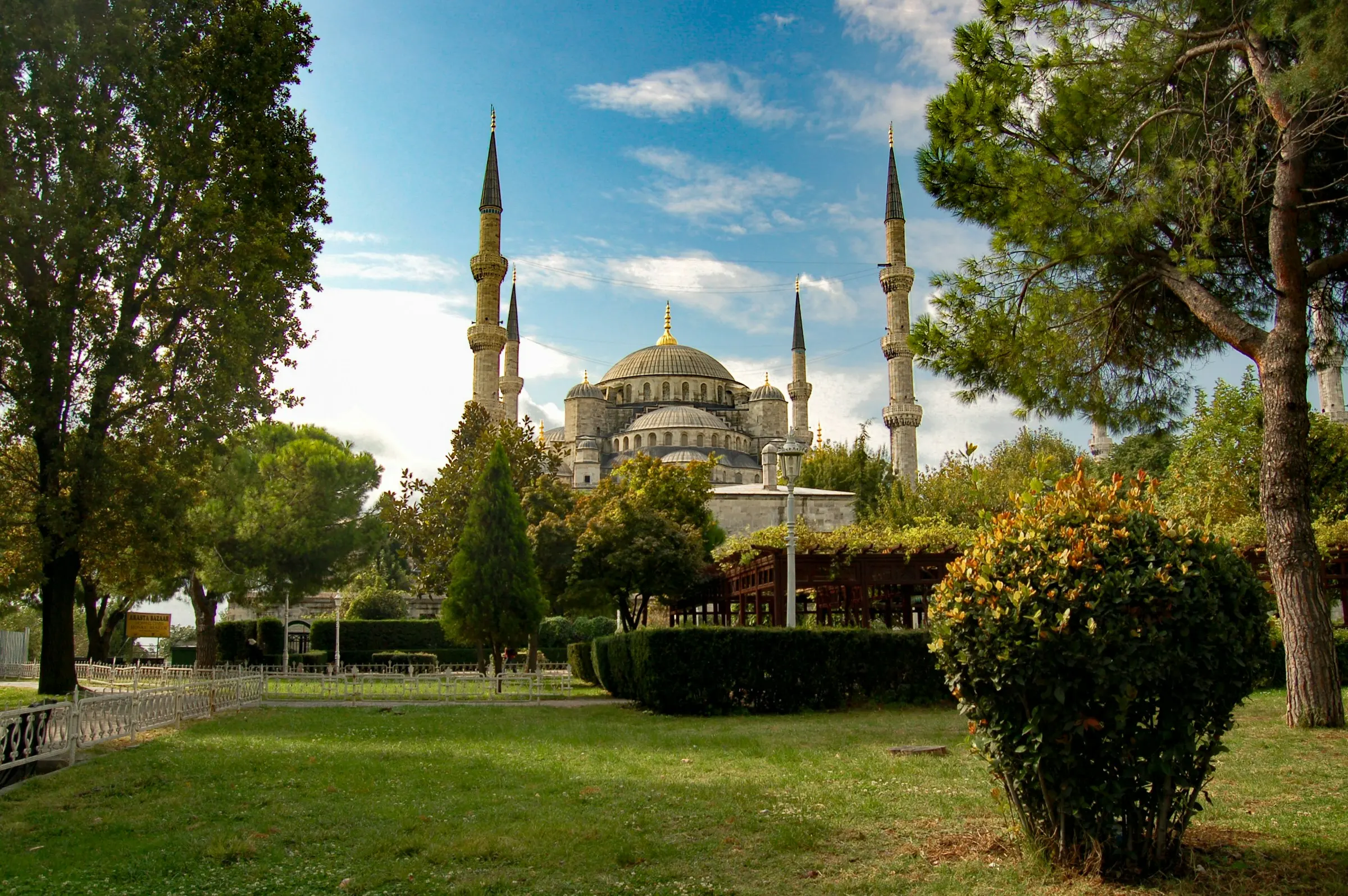
The Blue Mosque (Sultanahmet Camii) sits on the square's eastern flank — the 1616 Ottoman mosque whose six minarets and cascade of half-domes define the skyline above the Hippodrome. Visiting it back-to-back with the square ties the Ottoman chapter of the story directly to the Byzantine one beneath your feet.
Hagia Sophia is ninety seconds north, the cathedral-turned-mosque that the Nika riots indirectly built. It is the natural pairing for anyone who has just read the square's history, and doing the Hippodrome immediately before it lets the whole 532 story land as you walk through the cathedral door.
The Basilica Cistern (Yerebatan Sarnıcı) sits across the street, an underground sixth-century Byzantine reservoir built under Justinian — the same emperor whose reign the Hippodrome nearly ended. It is an atmospheric thirty-to-forty-five-minute contrast to the open daylight of the square.
The Museum of Turkish and Islamic Arts, in the İbrahim Pasha Palace on the western edge, overlooks the square the sultans once watched festivals from, and Topkapı Palace with its garden, Gülhane Park, lies a few minutes north-east. If you want to see the whole cluster in order, our one-day İstanbul walking itinerary chains the Hippodrome between the Blue Mosque and Hagia Sophia with the walking times clocked. Heading on to shop afterward? The Grand Bazaar is about ten minutes uphill — our Grand Bazaar survival guide covers the gates and the haggling. Each of these sits on our Stadtly İstanbul itineraries, mapped with the walking paths between them.
Fitting the Hippodrome Into a 1- or 2-Day İstanbul Trip
The Hippodrome is rarely a destination on its own — it's the connective tissue of a Sultanahmet day. Because it's free and open at all hours, it slots into any gap: a fifteen-minute walk between two timed mosque visits, or a floodlit evening stroll after dinner. On a one-day plan it's the natural hinge between the Blue Mosque and Hagia Sophia, and on a two-day plan it's the easiest thing to fold into a slower evening.
For one-day visitors, walk the square in the late-morning gap between the Blue Mosque and Hagia Sophia, or use it as the prayer-time buffer when the mosques close to tourists. Our essential one-day İstanbul itinerary places the square exactly there, between the morning mosque visits, so the timing takes care of itself.
For two-day visitors, an unhurried evening walk on Day 1 is the move — the square floodlit and nearly empty, the monument bases readable without the daytime crowds. For a calmer pace overall, the two-day first-timer route keeps all of Sultanahmet on Day 1 and frees Day 2 for the Bosphorus and Galata. And if you care about the history, the single best sequencing trick in the whole district is to do the Hippodrome immediately before Hagia Sophia — so the Nika-riots story is fresh in your mind as you walk into the cathedral it produced.
Frequently Asked Questions
Is the Hippodrome of Constantinople still standing?
Partly. The racetrack and stands are gone, but the open square — now Sultanahmet Meydanı, or At Meydanı — preserves the original footprint, and three ancient monuments still stand on the former central median. The curved southern substructure, the sphendone, also survives beneath the modern square.
Do you need a ticket to visit the Hippodrome?
No. The Hippodrome is a free, open public square with no gate, no ticket, and no closing time, so you can walk it at any hour. Only the surrounding attractions — Hagia Sophia, the Blue Mosque, the Basilica Cistern — charge admission or keep set visiting hours.
What are the three monuments in the Hippodrome?
The Obelisk of Theodosius, an Egyptian obelisk carved around 1450 BCE for Thutmose III; the Serpent Column, a bronze monument cast in 479 BCE and brought from Delphi; and the Walled Obelisk, a masonry obelisk once sheathed in bronze. A neo-Byzantine German Fountain from 1901 stands at the northern end.
What were the Nika riots?
The Nika riots of 532 CE were a roughly six-day revolt that began at the Hippodrome over a chariot-race dispute and nearly overthrew Emperor Justinian I. Procopius reports around 30,000 people killed inside the stadium — an ancient estimate. The uprising burned down the second Hagia Sophia, prompting the cathedral that stands today.
Where is the Hippodrome and how do you get there?
It sits in Sultanahmet on İstanbul's historic peninsula, directly between the Blue Mosque and Hagia Sophia. The T1 tram stops at Sultanahmet station, a two-minute walk away. From Taksim it's about a 25-minute tram ride; from İstanbul Airport, roughly 70 minutes by metro and tram.
How long do you need at the Hippodrome?
Allow fifteen to twenty-five minutes to walk the square and stop at each monument, or up to forty minutes if you study the carved base of the Obelisk of Theodosius. Because it's free and central, most visitors fold it into a wider Sultanahmet morning rather than visiting it alone.
Why is the Hippodrome called At Meydanı?
At Meydanı means "Square of Horses" in Turkish — the Ottoman name for the site after 1453, recalling its origin as a chariot-racing stadium. Races stopped under Ottoman rule, but the square stayed the city's main ceremonial and festival ground, a role it has kept into the present day.
Plan Your Sultanahmet Day on Stadtly
The Hippodrome is the rare site that means almost nothing at a glance and almost everything with context. Spend twenty minutes here knowing what happened on this ground — the races, the riots, the looting, the long afterlife as At Meydanı — and an empty-looking square becomes the single most concentrated piece of Byzantine and Ottoman history in the city. It is also, conveniently, free, central, and open whenever you happen to walk past.
If you're ready to build the rest of your trip around it, start with our 24-hour İstanbul plan for a walkable Sultanahmet day, or stretch it into a 48-hour first-timer route that pairs the historic peninsula with the Bosphorus. Both itineraries are built on Stadtly's map, fully editable, and free to save, share, or export as a PDF before you fly.
Planning a trip to Istanbul?
Discover attractions, hotels and tours to build your perfect itinerary.
Explore Istanbul